Emperor Norton Bay Bridge
Proclamation:
WHEREAS historical precedent clearly indicates the span between San Francisco and Oakland should be named after Emperor Norton I; by the powers vested in me, I hereby declare both the eastern and western segments to be named “The Emperor Norton Bay Bridge”.

and WHEREAS whoever after due and proper warning shall be heard to utter any other abominable name with obviously no historic or other warrant THEREFORE shall be deemed guilty of a High Misdemeanor, and shall pay into the Imperial Treasury as penalty the sum of one hundred dollars.

(as illustrated by @darth)
And please SIGN THE PETITION and CALL your state representative.
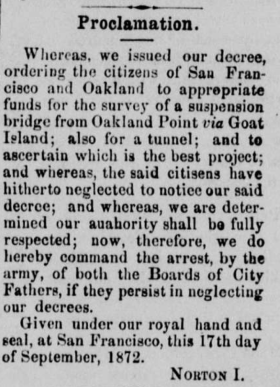
Here is Emperor Norton’s original Bay Bridge Proclamation from the March 23, 1872 Pacific Appeal, along with his September 1872 bridge/tunnel survey proclamation:

Historical update — looks like Emperor Norton first proposed the bridge in January 1872:
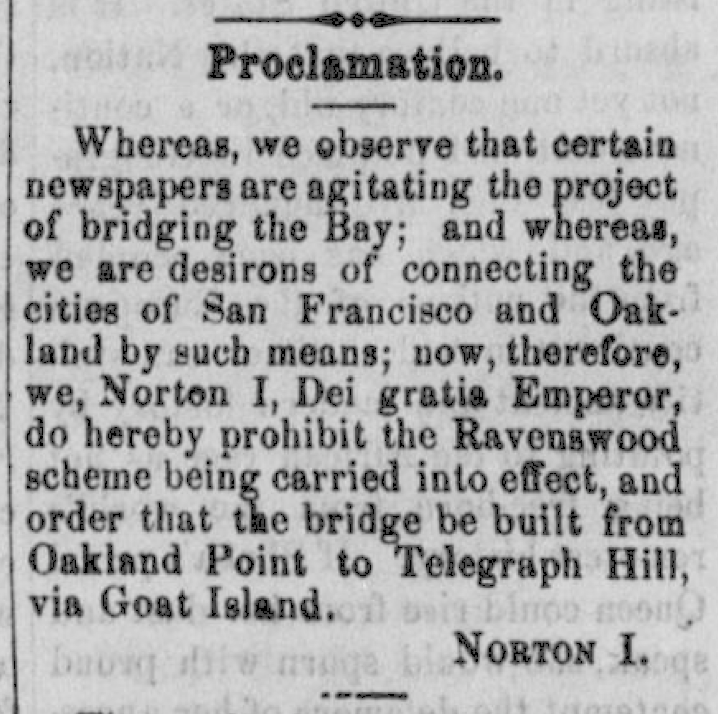
(Ravenswood=East Palo Alto. And all the politics and money of the day of where a bridge should go.)
(This being the internet, there is of course a collection of all of Emperor Norton’s proclamations available.)
@lukasb raises a good point on the short form:
I suggest “The Emperor” — “Traffic approaching the Emperor is backed up past the Maze.”
Here’s the first crossing video I’ve seen (sped up 4x).
and an upward looking fisheye video I made:
Some will miss the old cantilever more than others.
Psychologically, I liked the cantilever better. It was the only Bay Area bridge left that your kid could build with an erector set, and there was something calming about that. The view will be better on the new bridge, but I felt contained on the cantilever. If that epic gust of wind ever came up while I was driving a U-Haul, I would bounce off one of the girders and continue my journey.
My blood pressure won’t drop on the eastern span any more. Darth Vader’s theme is what comes to mind. I will always look at that blocky white tower the same way I look at 747s. “How is that @#$%ing thing keeping us from all falling into the bay?”
I wasn’t surprised to learn that engineers designing the old span in 1932 knew that the cantilever design was ugly.
“We have made several layouts in an effort to develop a structure more pleasing in appearance than a conventional cantilever.”
They considered several other designs, including—wait for it—a self-anchored span. But it was considered too expensive. The cantilever design was chosen not just for cost, but because the pilings couldn’t reach bedrock.
This and many other fascinating details in this historic engineering record…
…including a slideshow, and a schematics .

And don’t forget those who put it together, including the 28 known fatalities (p. 199).
And here’s the first wave of traffic passing over the Emperor:
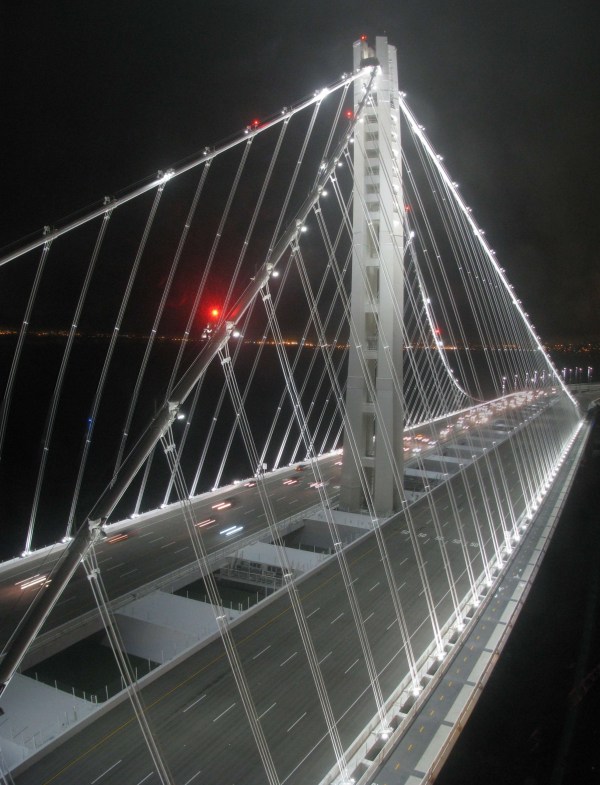
(I cheated a bit on both photos — the top part is from a construction webcam snapshot taken earlier in the week, while the bottom parts were from the same webcam the night The Emperor opened.)
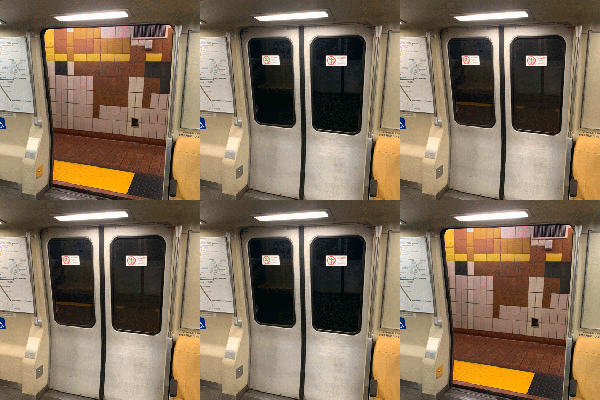
BART through the fog

San Franthropomorphicism
Looking west over San Francisco’s anthropomorphic Twitter accounts:
@SutroTVTower, @555CaliforniaSt @SFBayBridge, @TransAmericaBdg and of course @KarlTheFog
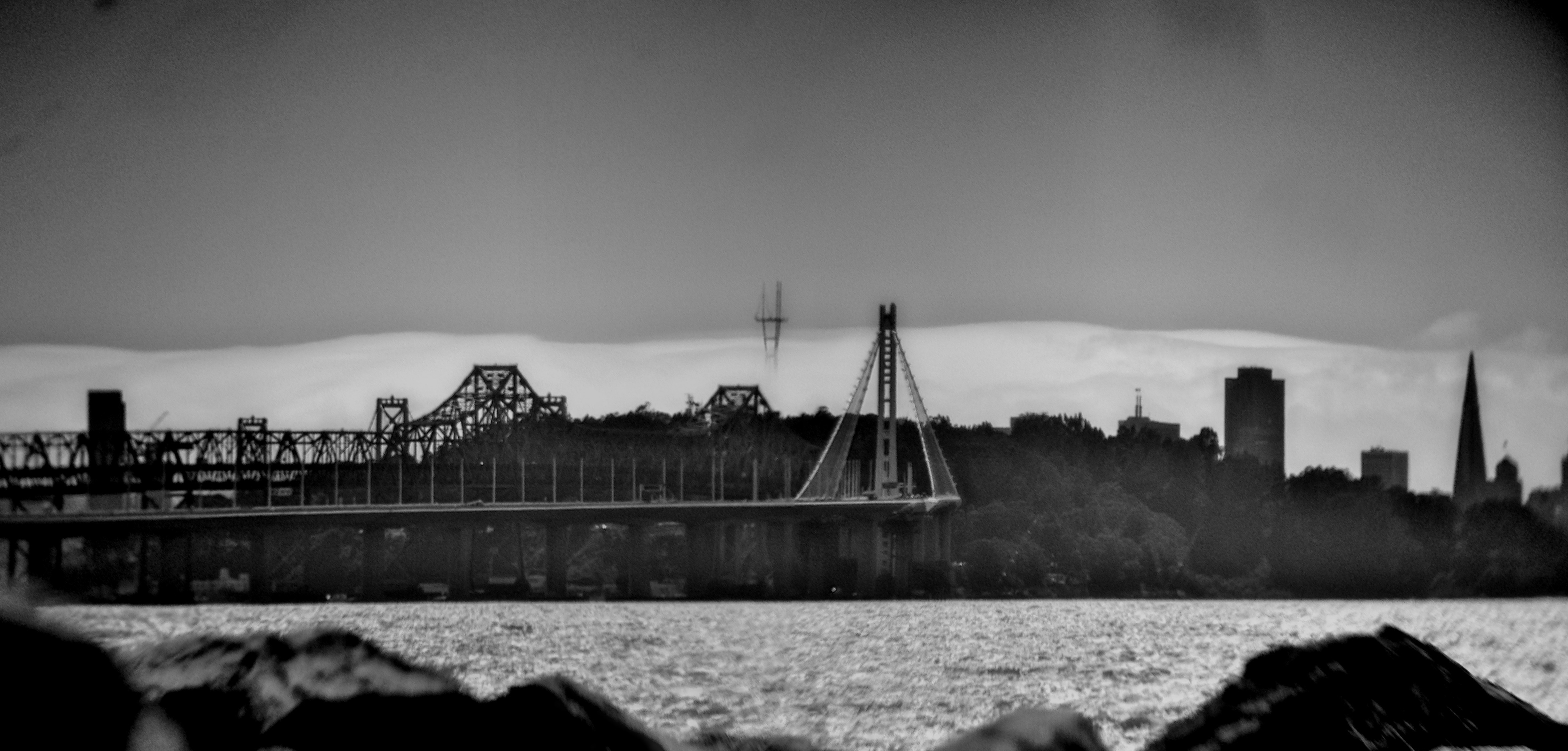
(Are the Oakland Cranes on Twitter?)

Sutro Time Machine
Last night’s lightning revealed many secrets about Bay Area infrastructure. First, this photo by @wxmann reveals exactly how Imperial AT-ATs are made:

zoom and enhance:
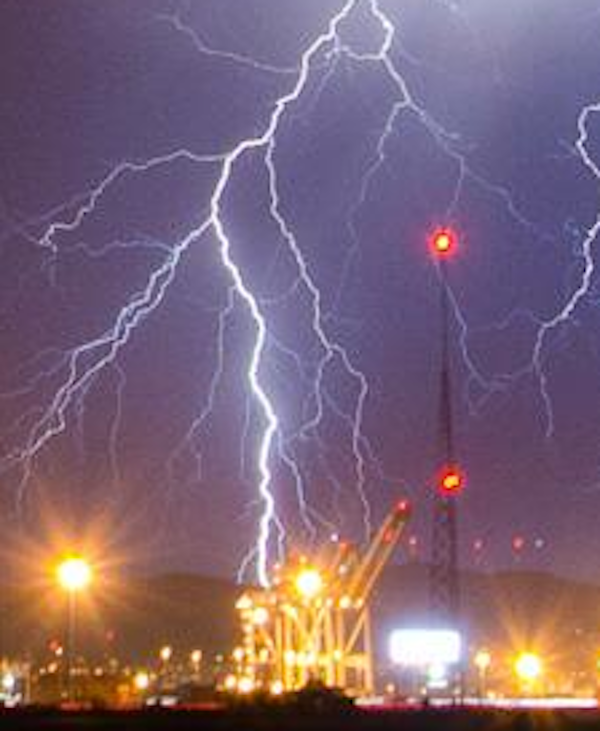

As long time readers will remember, Sutro is no stranger to lightning, as we saw last year.
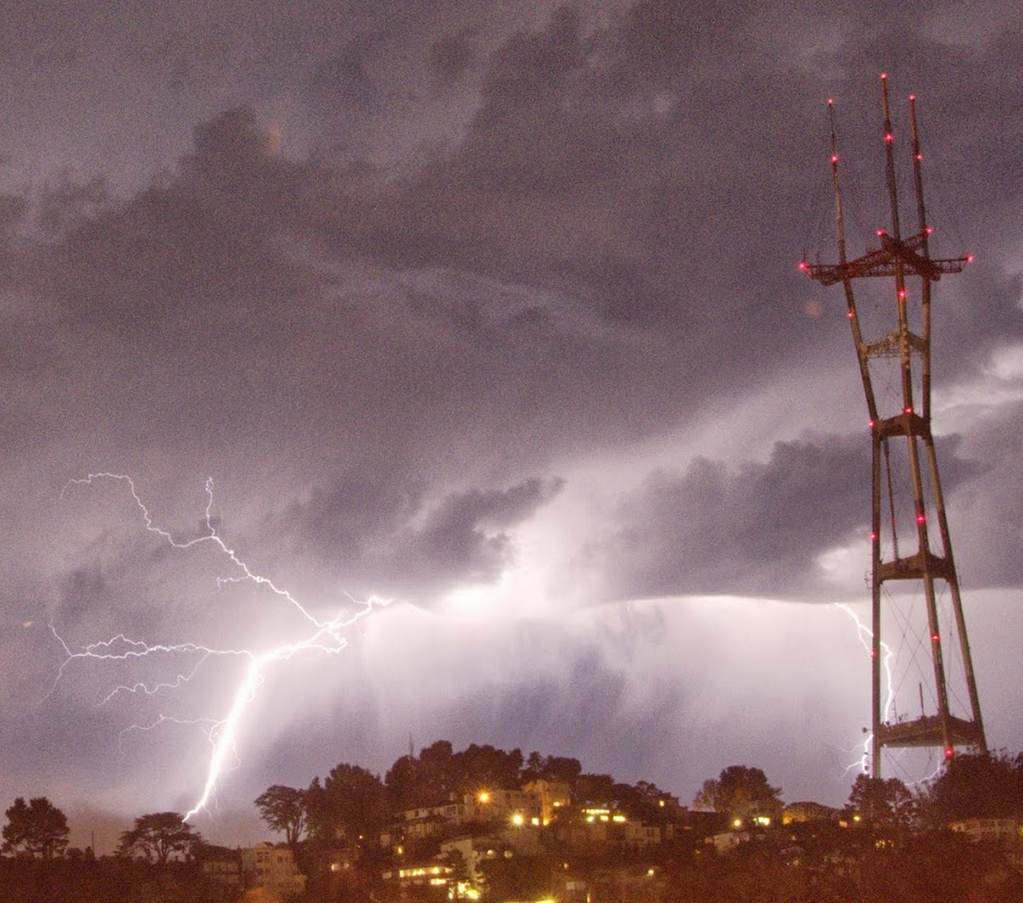
However, @SFEricM captured a rather dramatic backdrop last night:
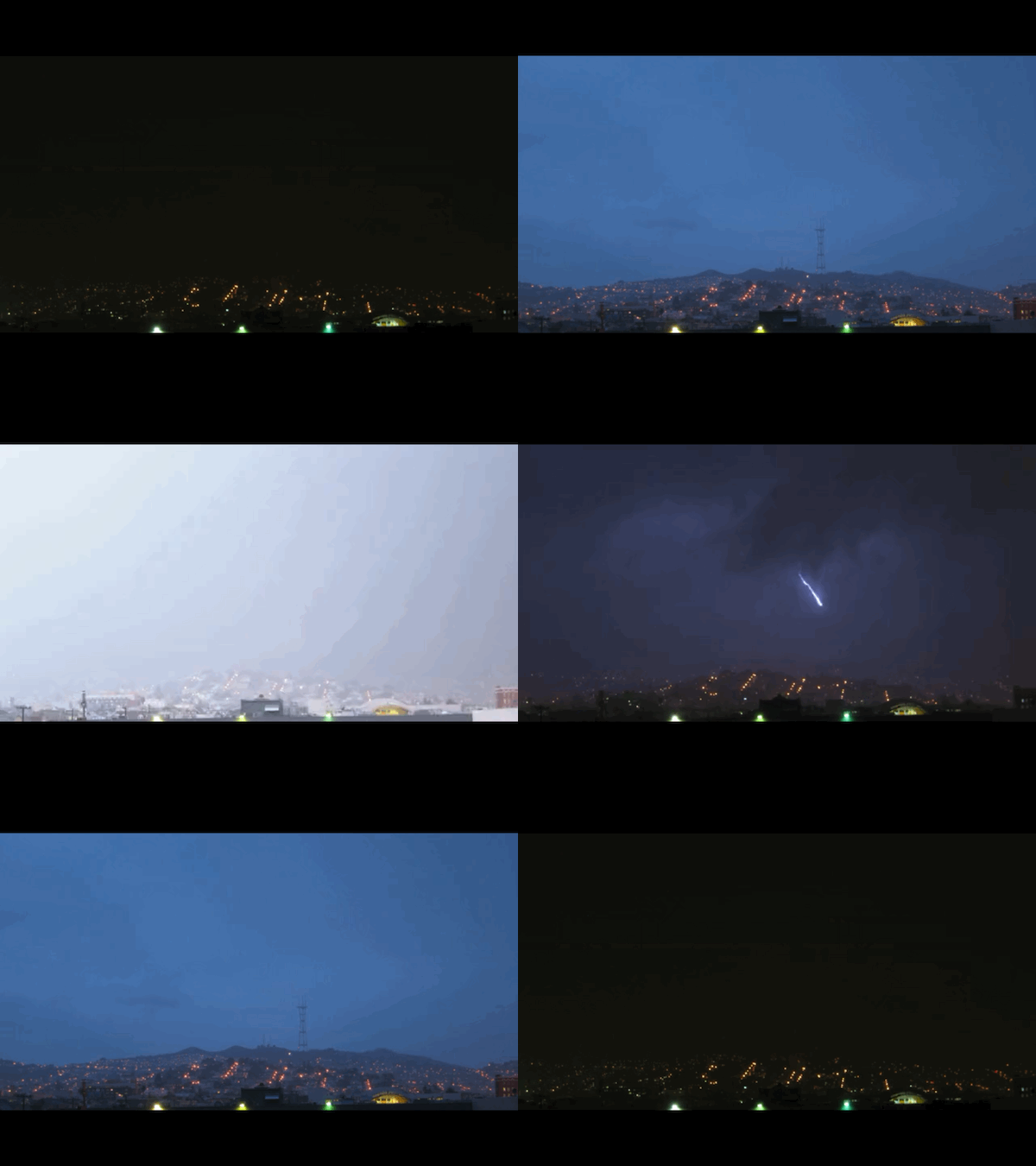
Apparently last night’s storm was enough to allow Sutro to TRAVEL BACK IN TIME, as discovered by @jasonbentley:

Looking through my archives, strangely enough, I am now finding pictures of Sutro in many historical eras! Behold this 1889 Edison-era footage of Sutro:

Sutro 1889a FTW
If you find any evidence of Sutro prior to 1973, please let me know and I’ll insert it here.
The Flags of San Francisco
Hey, did you know San Francisco has a flag?!? (I mean, other than the Castro flag.)

Lots of history behind this — the very wooden early San Francisco burned down many times:
1849: Dec 24
1850: May 4
1850: Jun 14
1850: Sep 17
1851: May 3
1851: Jun 22
While I love the IDEA of our flag, I don’t actually LOVE our flag. It’s kind of… meh, to be honest. And apparently I am not the only one. The all-powerful and knowledgeable Roman Mars noted the same when he moved to Chicago from SF. (A worthy podcast.)
So when I moved back to San Francisco in 2008, I researched its flag because I’d never seen it before in the previous eight years that I’d lived here. And I found it … I’m sorry to say, sadly lacking.
He even interviewed a vexillologicist, Ted Kaye, on what makes a good flag.
No lettering or seals. Never use writing of any kind. If you need to write the name of what you’re representing on your flag, your symbolism has failed.
So San Francisco obviously is mocked in vexillologicist parties, though we are in good company as they also think the text on the California flag is ridiculous.
At this point in this post, it should be obvious that I am going to propose a few alternate designs for the San Francisco flag. However, before we get to my modest proposals, I think it is important to review prior art. The most prominent of these was commissioned by the Bold Italic, defender of irony. (I suggest some sort of protective eyewear before your read any further.)

OMG accident at the stained glass factory! Or perhaps the Anchor Steam and Prohibition bottling plants collided?
One obvious alternative would be a Sutro-themed flag:
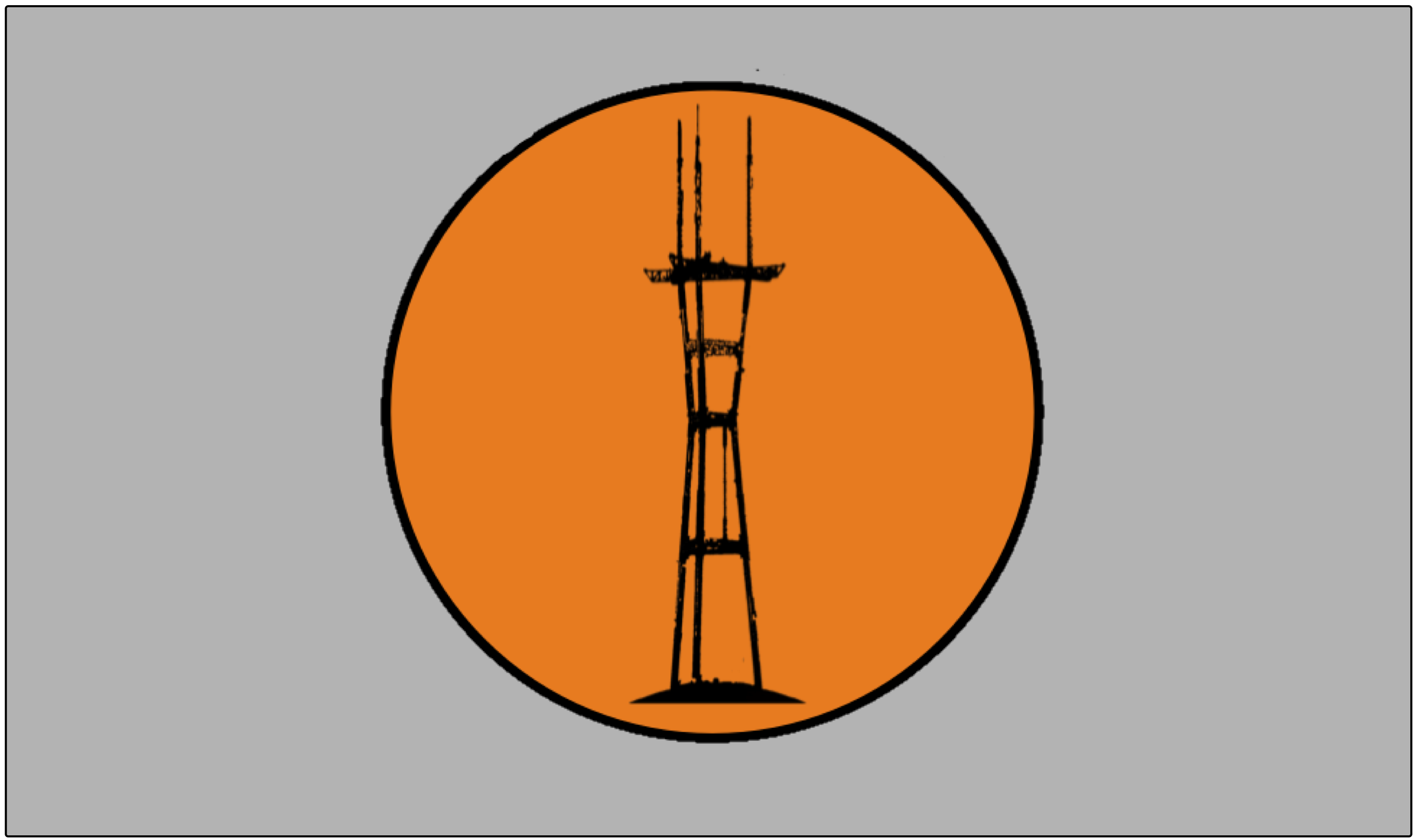
It even comes with its own anthem!
Anyway, one big update you could make would be the logo. Iron and gold and fire is great, but let’s bring it into modern times.

Ted Kaye and Roman Mars and I are in agreement about one thing — the gold border is cool. And the phoenix is awesome. But just not THIS phoenix. (Or the phoenitalix…)
Behold my modest proposal, using vexillological principles:

Yeah, a kid could TOTALLY draw this.
I’m not sure how I feel about the brown. (What color were phoenixes anyway?) So here’s a version with more red.

Of course, this being the internet…
https://twitter.com/Lahlahlindsey/status/367749237238661120
FINE LINDSEY
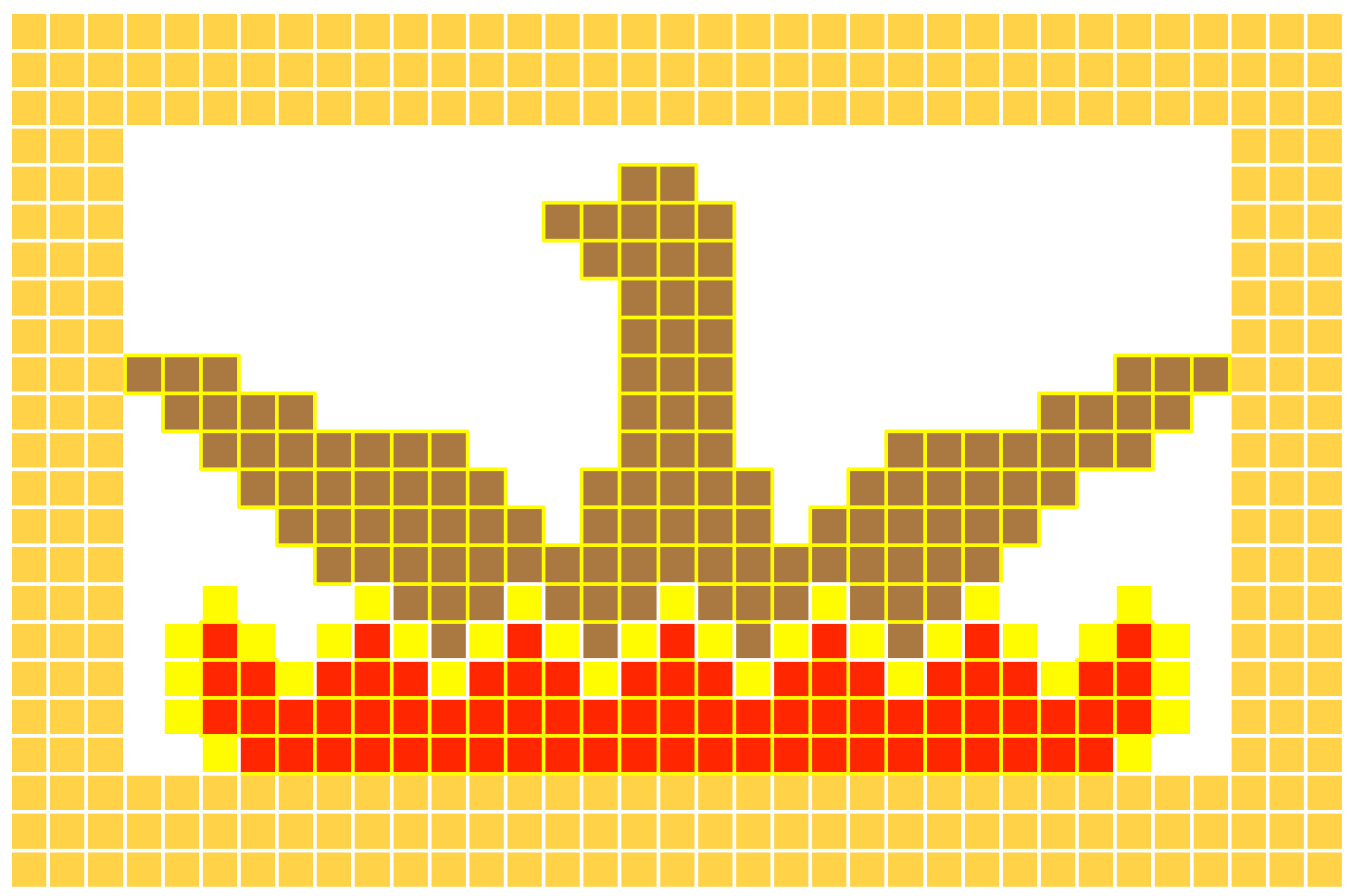
Now I just need to trick someone into making this into a GIF and we’d be all set for the next 164 years.
A Sad Day for IPA
Today is a very dark day in the history of IPA:
August 12, 1869
The [Edwin Fox] ran aground on the Coromandel Coast at 2 a.m. With assistance unavailable, the Master ordered 107 tons (446 hogsheads) of India Pale Ale jettisoned. The ship then drew herself out of the mud and reached port the next day.
In case you were wondering how much a hogshead is, the scientific measurement is A HELL OF A LOT OF IPA. 446 hogsheads would fill about THREE HUNDRED THOUSAND BOTTLES. (This might actually be more IPA than is consumed in San Francisco each day.)
This tragedy took place off the coast of India north of Chennai (as best as I can tell from the record near Machilipatnam):
https://findery.com/burritojustice/notes/aug-12-1869-the-edwin-fox-runs-aground-off
So please take a moment while drinking your daily ration of IPA, and think of the emotional horrors that the crew of the Edwin Fox suffered as they rolled hogshead after hogshead of IPA overboard.
Hey Lagunitas — here is an idea for a proper memorial:
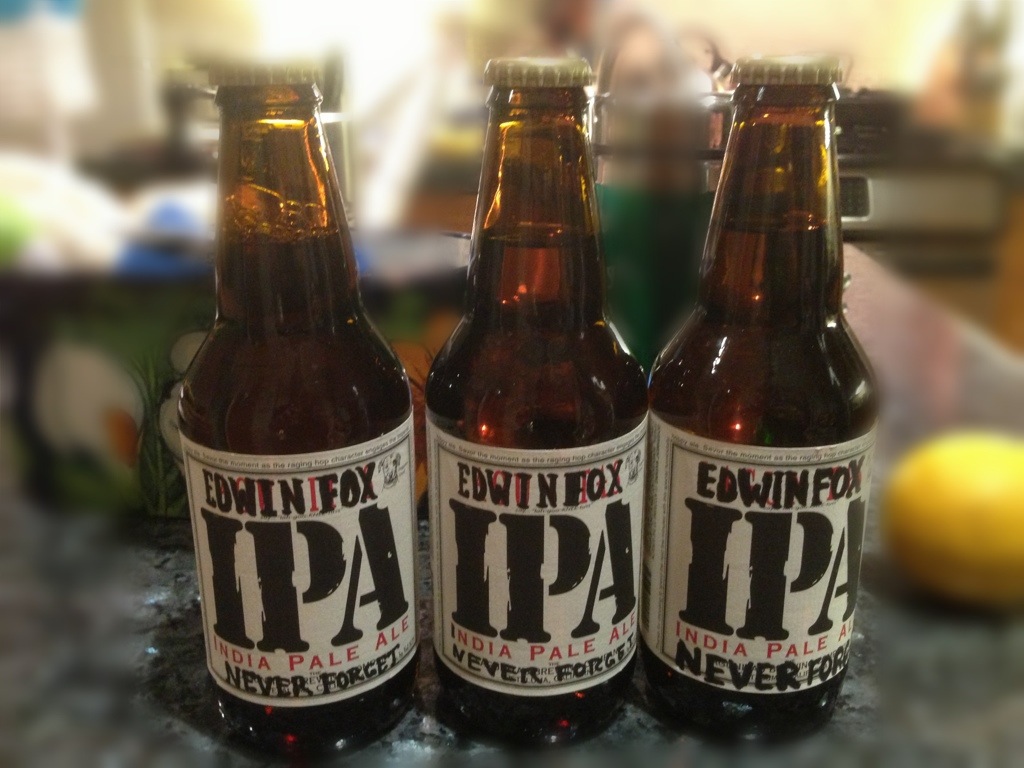
Much more on the Edwin Fox, IPA, Russian cruise ships, beer and San Francisco here.
Soviets map America
Following up on our previous discussion of Soviet Red Army maps of San Francisco, please study this 1979 Soviet map of the US economy and land use via @vrubareads.

Калифорния!

While I can piece together Cyrillic letters, I do not read Russian. However, @afiler was able to put together a handy Southern Californian pronunciation guide:
Looks like this was on Reddit a few days ago. Here is the key:
 and the land use:
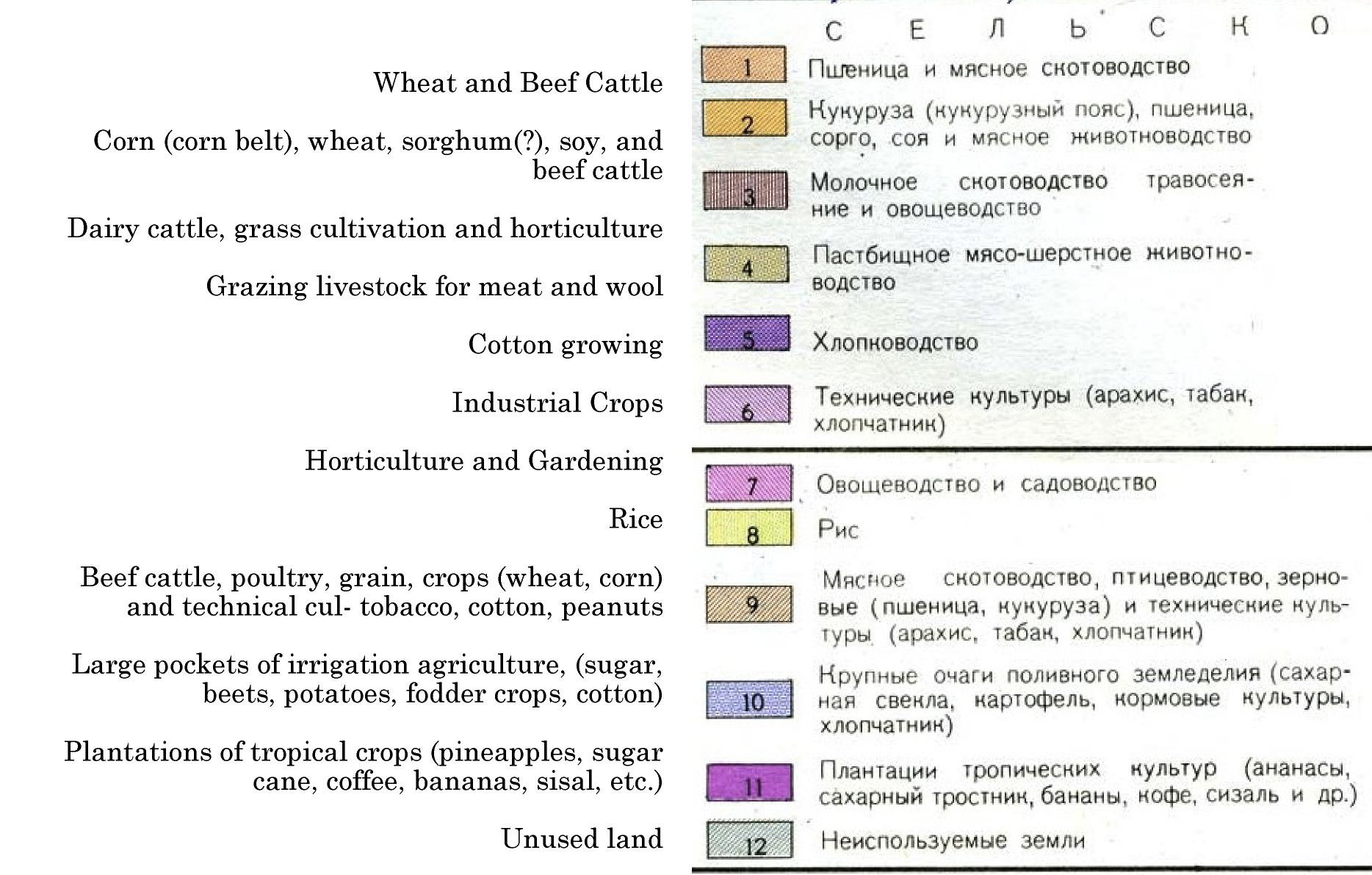
and agricultural symbols:

How to tweet from a Newton
The 20th anniversary of the Newton inspired me to pull out and dust off my old MessagePad 2100. I naturally tried to tweet from it.
This proved problematic thanks to https and oAuth — there was no way to get to mobile.twitter.com or authenticate with text-based sites like kindletwit.com.
Needless to say, I was not going to let this stop me. So here’s how to tweet from a Newton:
1) enable Internet Sharing on your Mac’s ethernet port
2) enable telnetd in launchctl
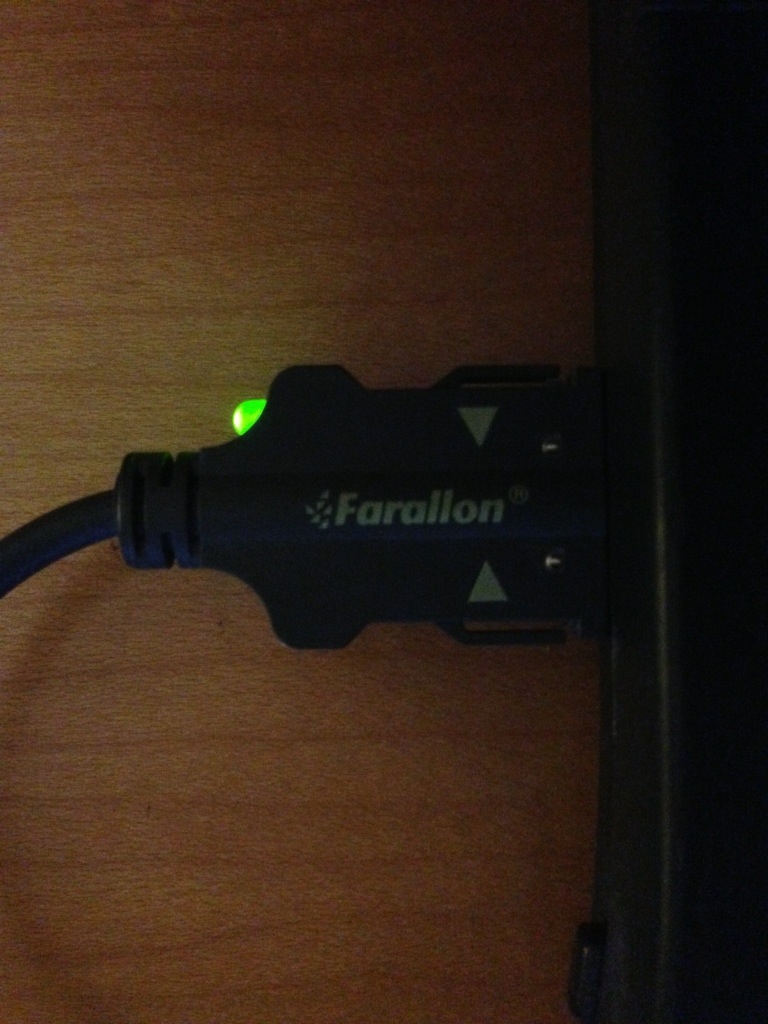
3) connect the PCMCIA Ethernet card (Farallon Networks!) to the Mac and enable DCHP in the Newton’s Internet Setup
4) use PT100 to telnet to 192.168.2.1 to get to the Mac OS X command line
5) ssh from the Mac to a unix host that has Lynx installed
6) lynx to m.twitter.com
7) tweet!
Added bonus — Newton panorama:

Additional added bonus: what this blog would have looked like in 1997:
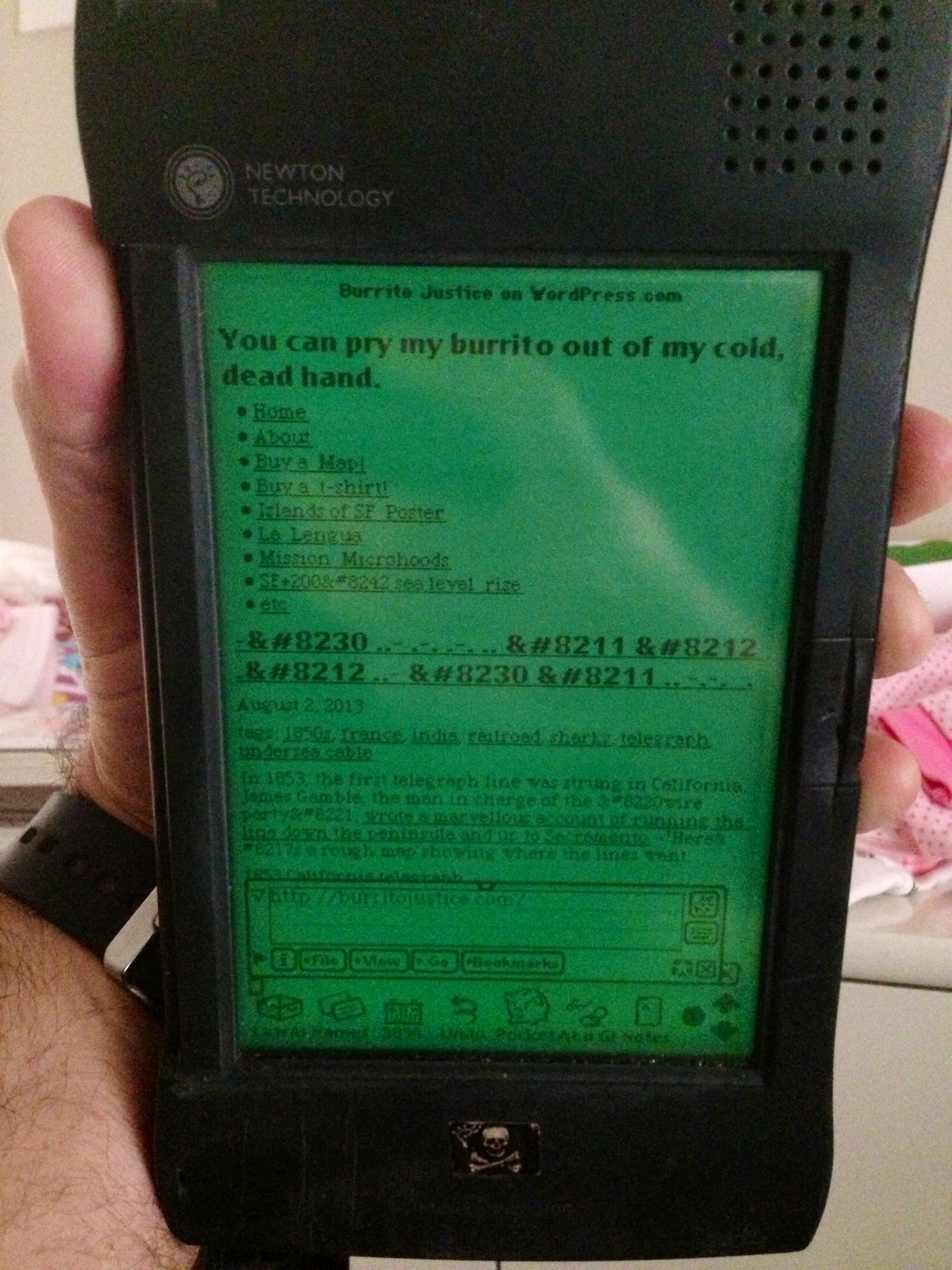
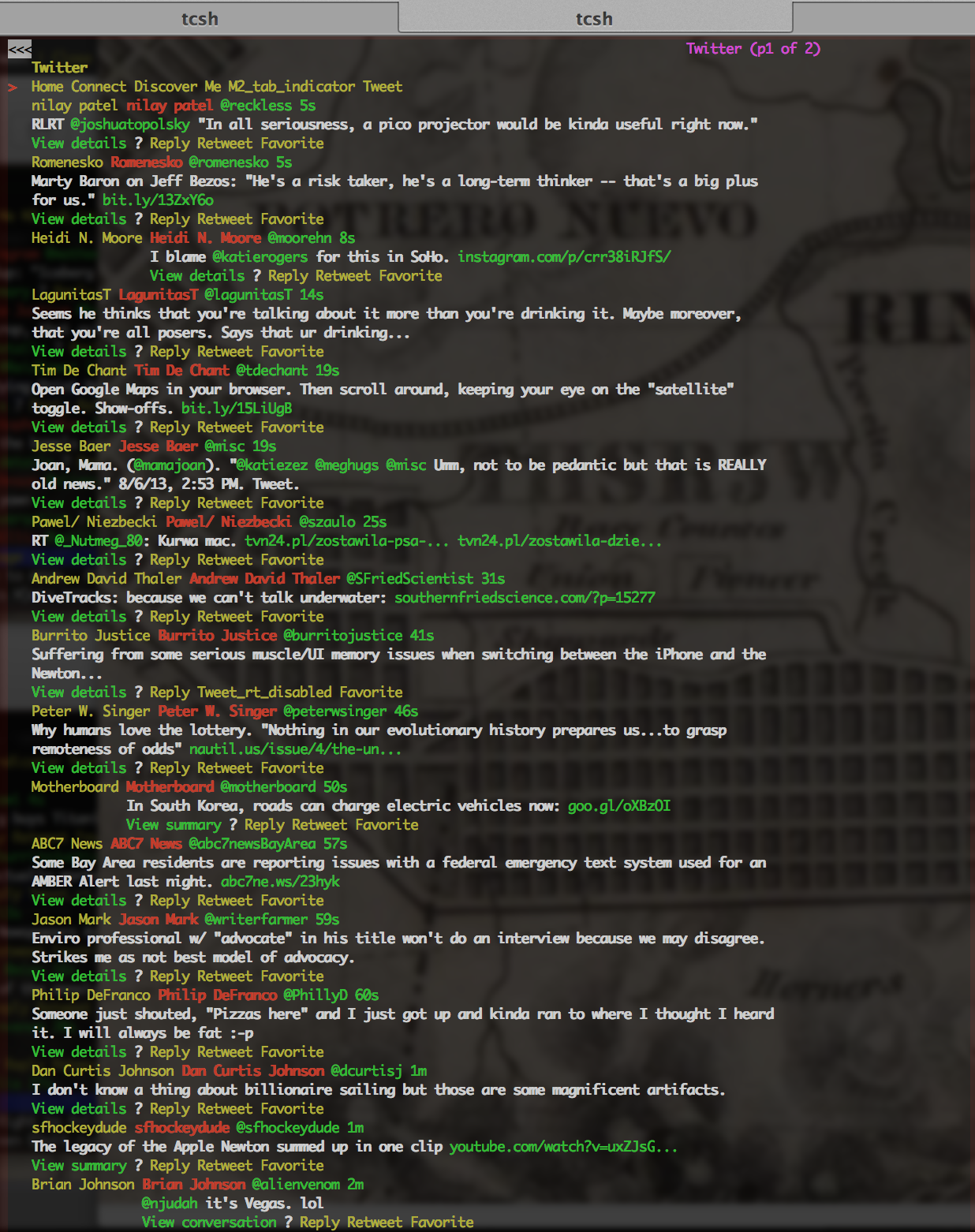
Extra additional added bonus: Lynx in Terminal handles Twitter’s mobile site pretty nicely:
Also, I miss Farallon Networks.
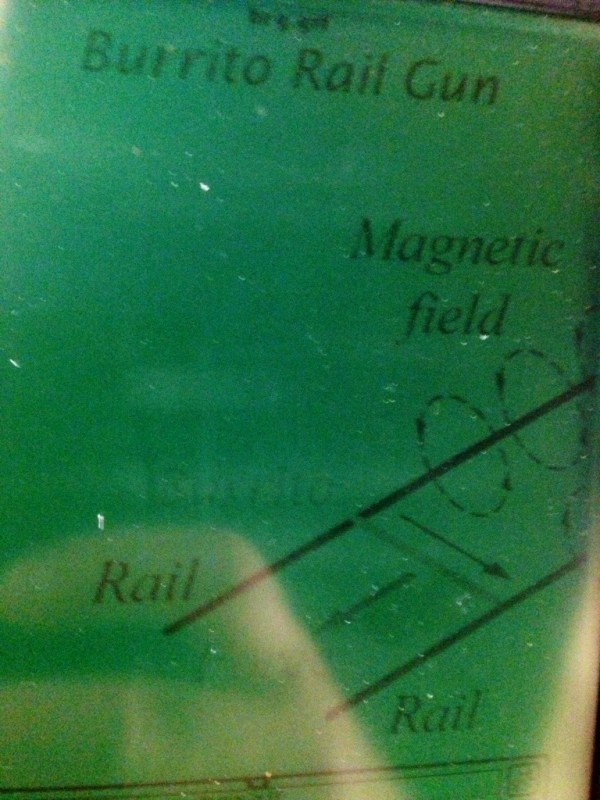
I tried to get the Newton to load my Burrito Railgun launch GIF, but it only has 4MB of onboard memory and the GIF is 5MB so that’s not happening. Better luck with the BRG GIF schematic.
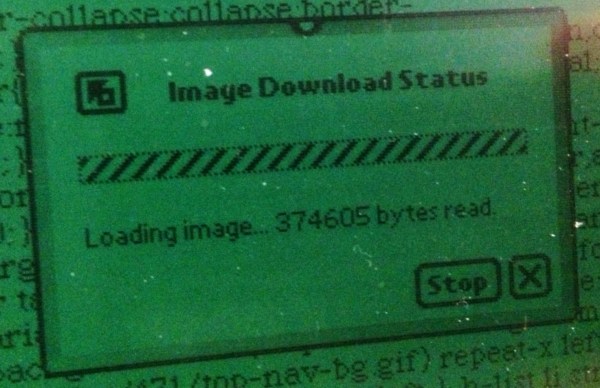
Back when bytes were big:
-… ..- .-. .-. .. – — .— ..- … – .. -.-. .
In 1853, the first telegraph line was strung in California. James Gamble, the man in charge of the “wire party”, wrote a marvellous account of running the line down the peninsula and up to Sacramento. Here’s a rough map showing where the lines went.

It should come as no surprise that the telegraph was almost stopped by @KarlTheFog:
Our little party worked energetically, and on the first day we strung up about three miles, camping for the night at what was known as the Abbey, a wayside house on the outskirts of the city. The next day we made about six miles, having commenced early in the morning and working until dark. The day had been a very foggy one, and as the country at that time was but sparsely settled, and but little land fenced in any direction, we found ourselves, when the day’s work was over, lost in the fog. Toward the close of the day, and shortly before leaving off work, we had noticed, as we came along, a squatter’s cabin, to which, having no tent with us, we had decided to return and seek shelter for the night. To find this cabin was now our great desire, that we might be protected from the cold winds and fog. Separating, but with the understanding that we should keep within hailing distance of each other, we groped in the dark and fog for more than an hour, but without success. The squatter’s cabin seemed to be a sort of befogged “Will o’ the Wisp”–with this difference, we were sure that it was there somewhere, but to save our lives none of us could find it. We finally determined to give up the search, roll ourselves up in our blankets, and make the best of it on the ground.
Luckily the march of technology was saved when James & friends bumped into the cabin while looking for firewood (in September), saving themselves from the dreary grey fate of Karl sapping their very will to live.
Seriously though, it’s hard to appreciate just how isolated San Francisco was in that era. The fastest Clipper ship from New York took 89 days. It was just 30 days if you cut over through Panama or Nicaragua (if you wanted to risk dying of malaria). Overland from Iowa was about three months. The Pony Express didn’t start until 1860 and took 10 days from Missouri (but it only ran for 18 months, cost about $125 per letter adjusted for inflation, and shut down 2 days after the transcontinental telegraph lit up in October 1861). The transcontinental railroad wasn’t completed until 1869.
Another way of looking at it — the people of San Francisco were so isolated they actually got excited about talking to people IN SAN JOSE. I mean, that’s pretty isolated. Consider that the cost for a telegram was 75 cents for 10 words, and 25 cents per 5 words after that. Adjusting for inflation, that’s about $21 for the first 10 words, and $7 for the next 5 words. Assuming a 140 character tweet is 25 words, that would run you $42 per tweet.
“The Abbey” that they refer to is visible in this rather ridiculously awesome 1851 map of the proposed rail route between San Francisco and San Jose (rotated for your viewing pleasure.)

Note the proposed path skipped the Bernal Cut and suggested a Bayshore route, aka Caltrain today.
Zoom and enhance — “Abbey Ho!” (That line is the road to San Jose.)
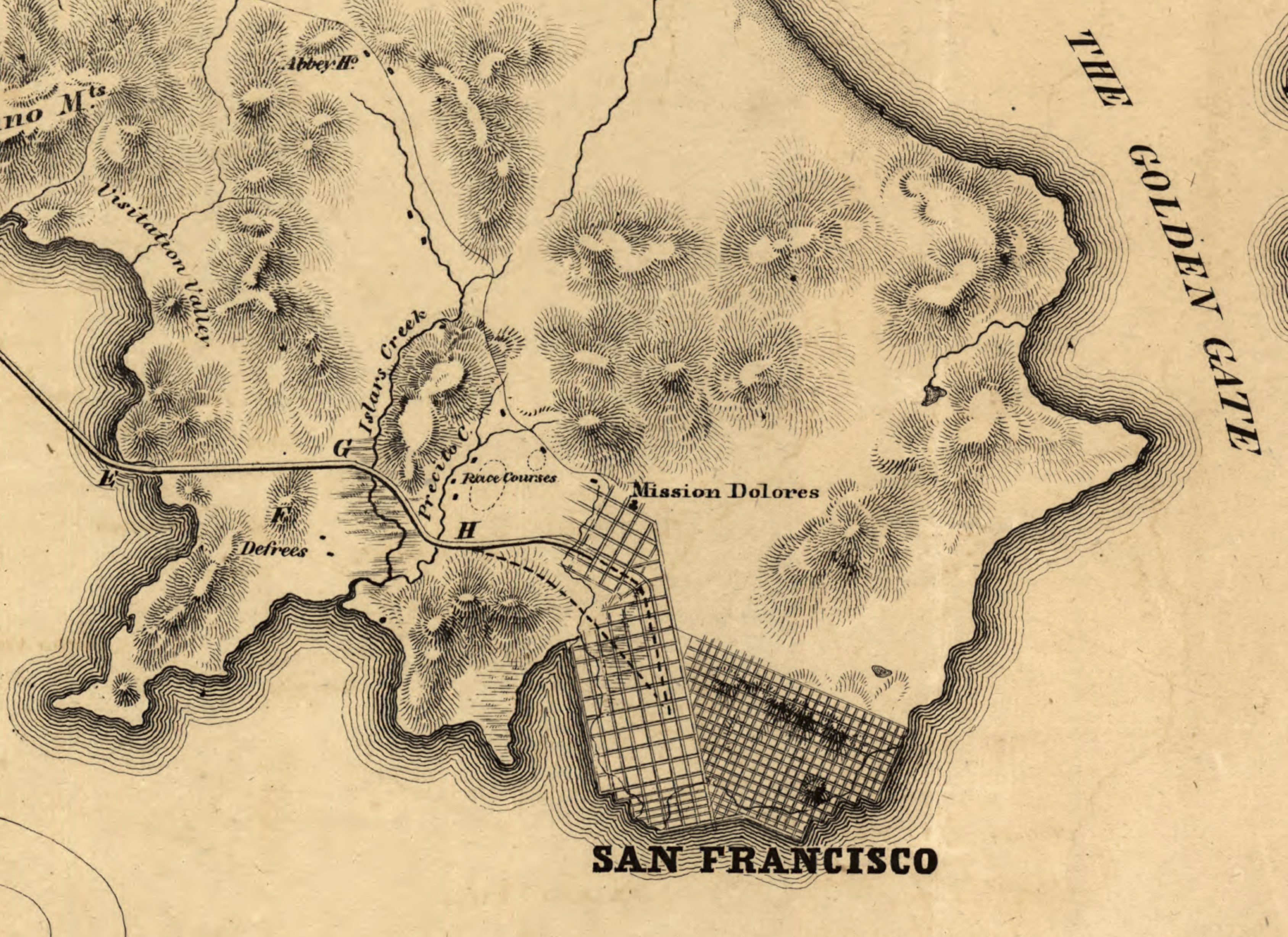
I see the Pioneer and Union race tracks! And Bernal! And Precito Creek! And Islars Creek!

I’m pretty sure the building between the forks of Precita creek is the Bernal Adobe. (Oh man, do I want a picture of that.)
This glorious map was part of a report made by William Lewis, the Chief Engineer of the Pacific and Atlantic Rail Road Company, which eventually built the railroad to San Jose in 1860-1864. The full report was published in the Dec 25 1851 edition of the Daily Alta, though the letters on the map aren’t referenced — fortunately for you, dear reader, I found them described on pages ii and iv of this version of the report.
I’m not sure what year the plan for the bridge was abandoned and decision was made to dig the Bernal Cut, but you can read about it in this interesting progress report from Nov 1862. (For reference, the Bayshore cutoff was built from 1903-1907.)
The Abbey is still visible in this 1867 map of the Bay Area via David Rumsey (at the bottom of the blue San Miguel outline), just outside the current city limits in Daly City.
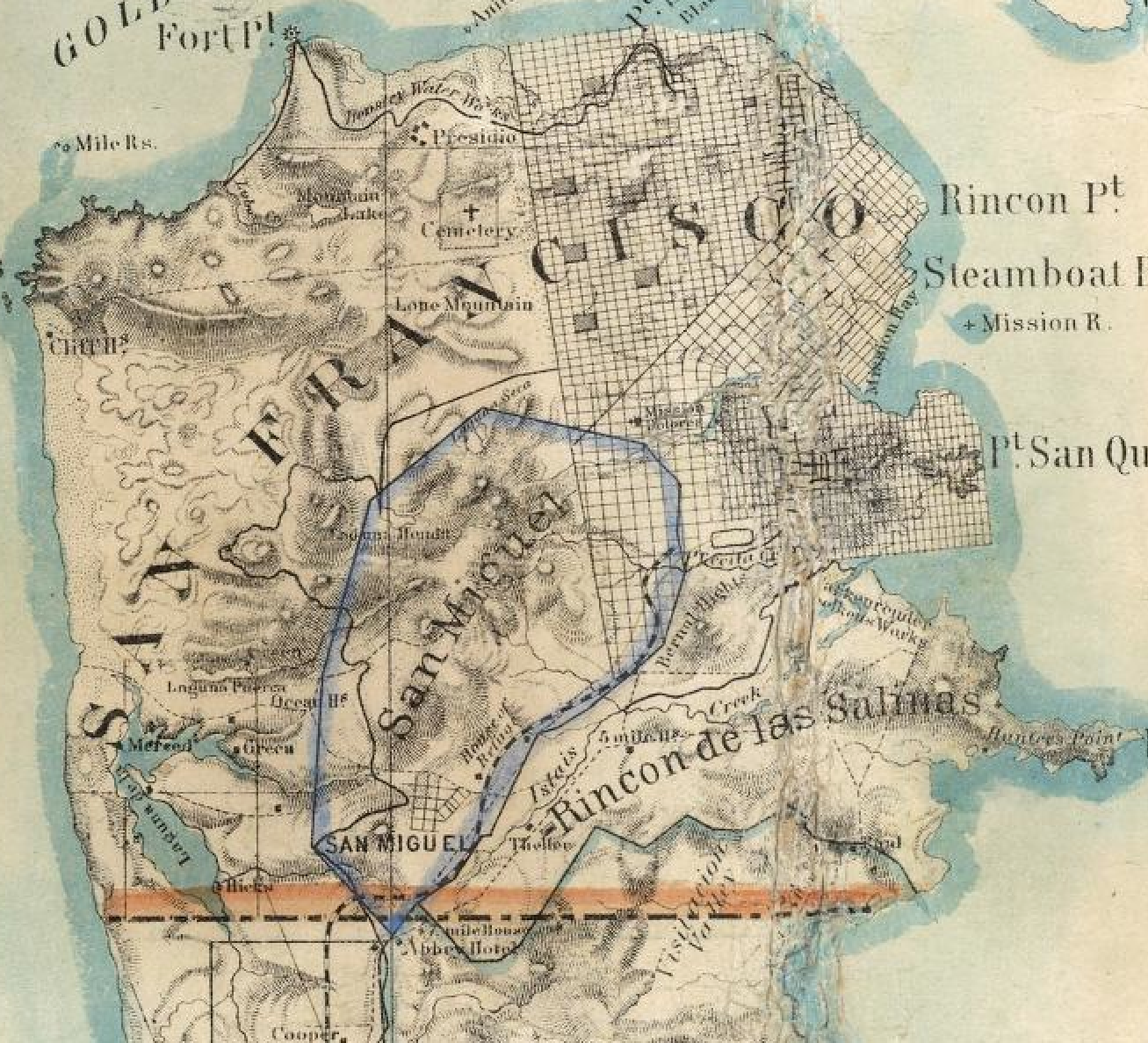
It’s crazy to think that just a few miles out of the city, there was little to nothing. Notice the 5 and 7 Mile Houses on the 1867 map — all must have been a big deal in the day. Hope they had beer too.
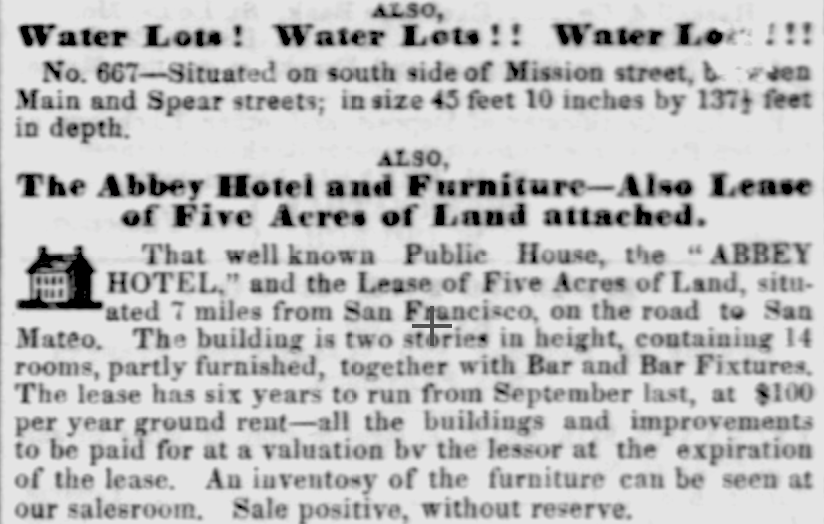
If you were around in 1854, you could have leased the Abbey Hotel for a very reasonable rate. Thankfully there was a bar (and fixtures!)
They also had DRAMA. In 1902, health inspector Rivers shot at a butcher, Samuel Aftergut, three times in the bar room of the Abbey. (Thanks @sfhistorian!) Note that the butcher had been on watch by the SPCA.

Man that is not going to help the Abbey’s Yelp score.
There was even a 4 Mile House between Mission and San Jose Ave on Randall (where the Shell station is).

Needless to say, I was surprised to find references to A STABBING AFFAIR and to MURDER in the Four Mile House:
1867:
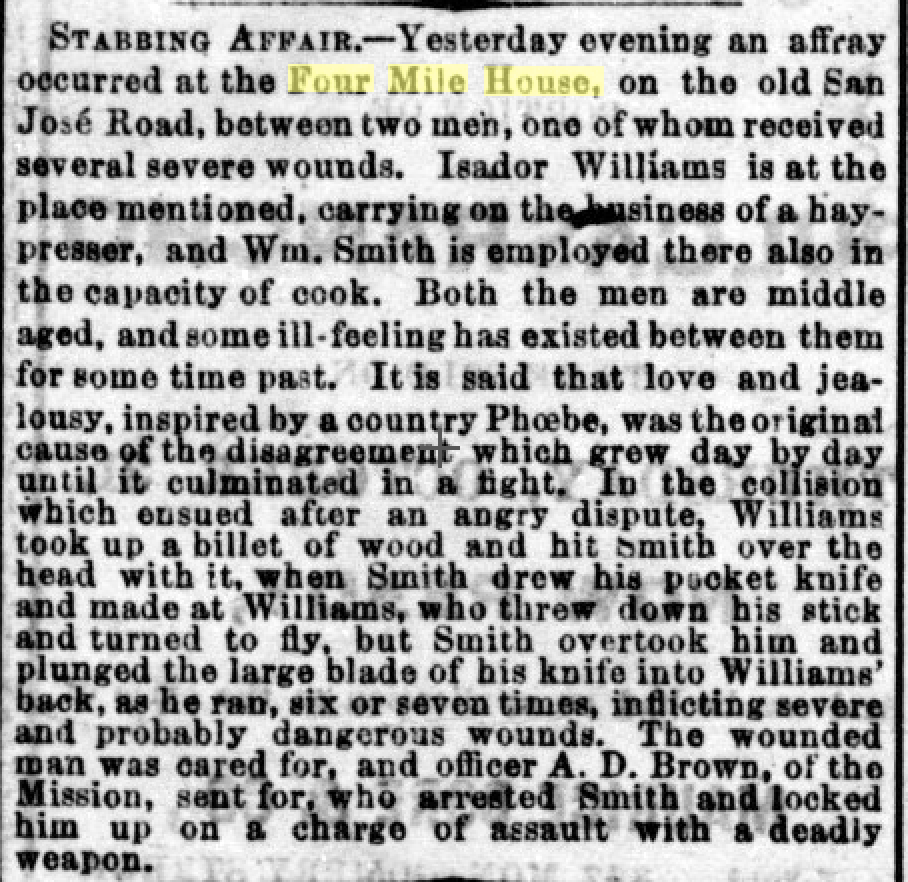
1889:
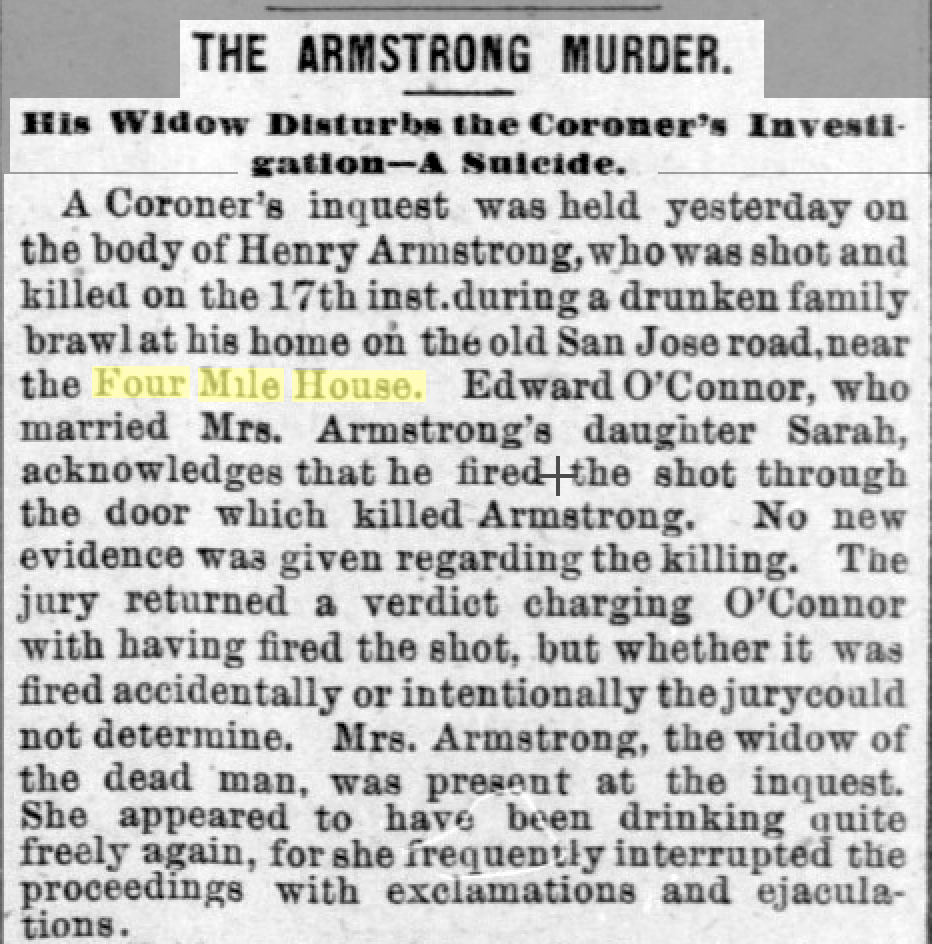
So maybe we skip drinks at the Four Mile House and the Abbey.
Speaking of telegraphs, you may have heard that after 150 years, India shut down its telegraph system in July. End of an era! Last telegram in the world! In fact, there was a such a fierce competition to send the very last one a week-long backlog built up.
Great story, except that telegrams as Samuel Morse would recognize them died out quite a while ago. As Ars Technica notes, what’s actually being discontinued by the Indian government is their Telex service.
Samuel Morse’s version of telegraphy—Morse code over the wire—died a long time ago. It was replaced by Telex, a switch-based system similar to telephone networks, developed in Germany in 1933. The German system, run by the Federal Post Office, essentially used a precursor to computer modems and sent text across the wire at about 50 characters per second. Western Union built the US’ first nationwide Telex, an acronym for Teleprinter Exchange, in the late 1950s.
|
|
|


Telegraphy really didn’t stand a a chance against the fax machine and text messaging. That being said, the Telex is alive and well in many countries.
“Italy still has a printer and Telex line in every post office,” said Stone. “And people still send loads and loads of telegrams there. It’s a state-run telegraph service, so I don’t know if it’s profitable or not. But it’s exactly as the service was run in India and the same as it’s been for 50 or 60 years.”
I guess there is something to be said about a message with legal standing from an established authority that you can wave around in front of someone. See McLuhan, medium vs message.
Of course, many forget that in the 1850s, electrical telegrams kicked the ass of the French optical messaging system, the Chappe Telegraph. It was a semaphore system that used a series of rotating bars and arms to transmit letters.
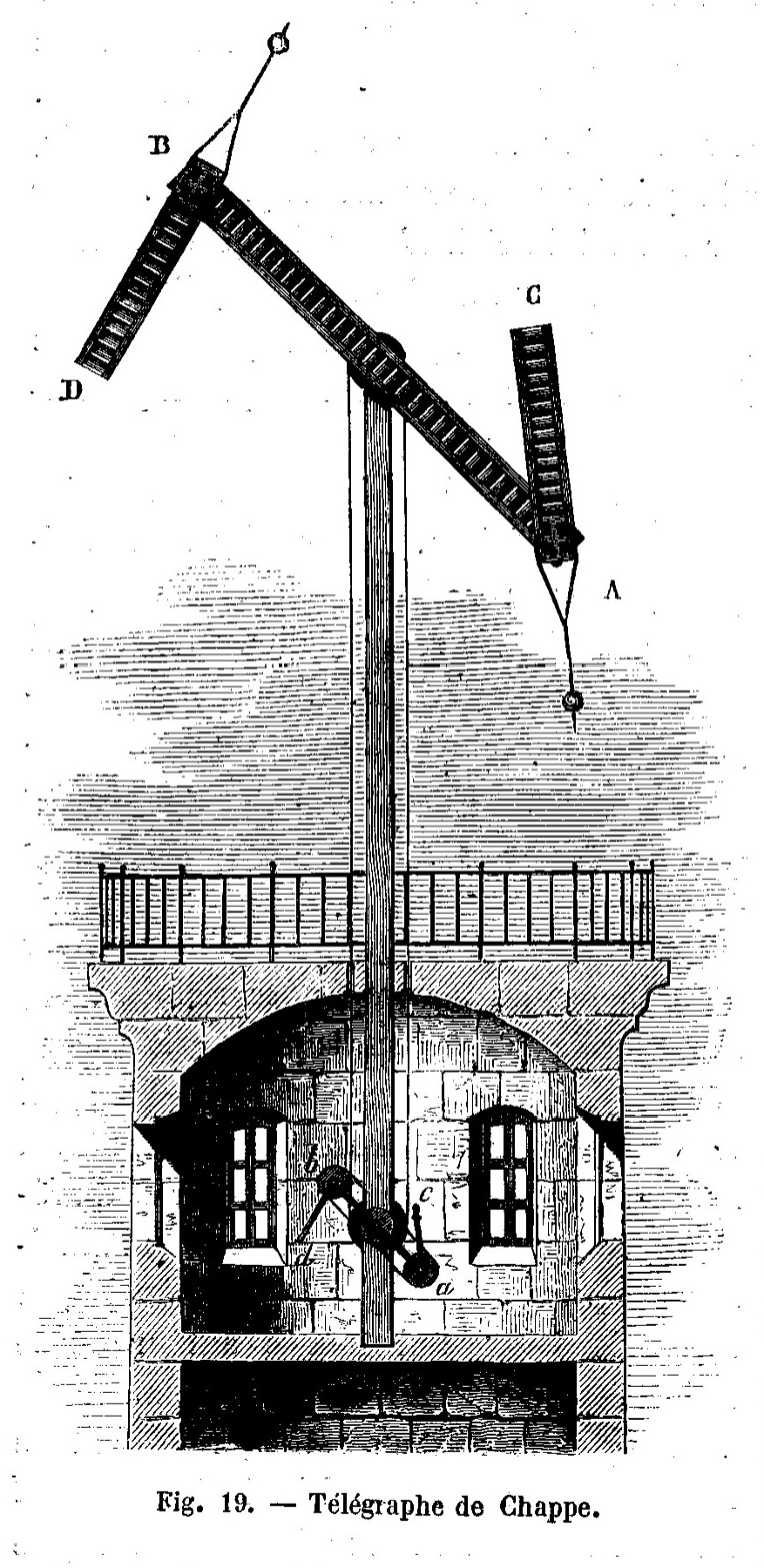
Here’s the conversion table:

While it could theoretically send a system from Paris to Toulon in 12 minutes, messages tended to take longer, if they got there at all that day.
“When rates were measured in the 1840’s, only two out of three messages were found to arrive within a day during the warm months, dropping to one in three in the winter.”
And it didn’t work at night. (Must… refrain… from… Corey… Hart… joke…)
But apparently it gave rise to a French idiomatic expression:
Basically the formation of a signal was done in two steps and three movements (the French expression “en deux temps et trois mouvements” still meaning today “rapidly done” comes from it).
But it worked well enough for 50 years.
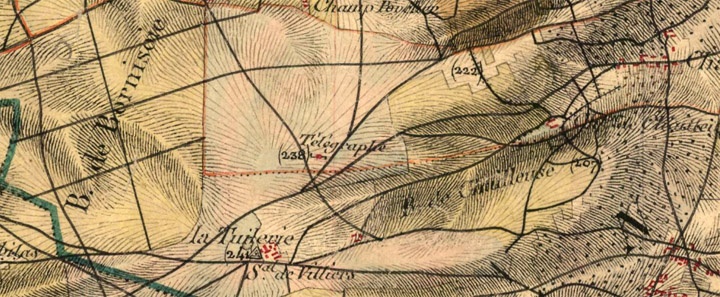
Here’s a nice little piece from the BBC on some guys trying to restore one of the stations. And here’s a paper that covers its development, along with some of the encoding and error corrections systems they developed. And an early 19th century topographic map showing one of the stations.
The system was extensive, and bears a (frankly unsurprising) resemblance to the French high speed rail network.

These maps from Wikipedia show construction dates for both systems.
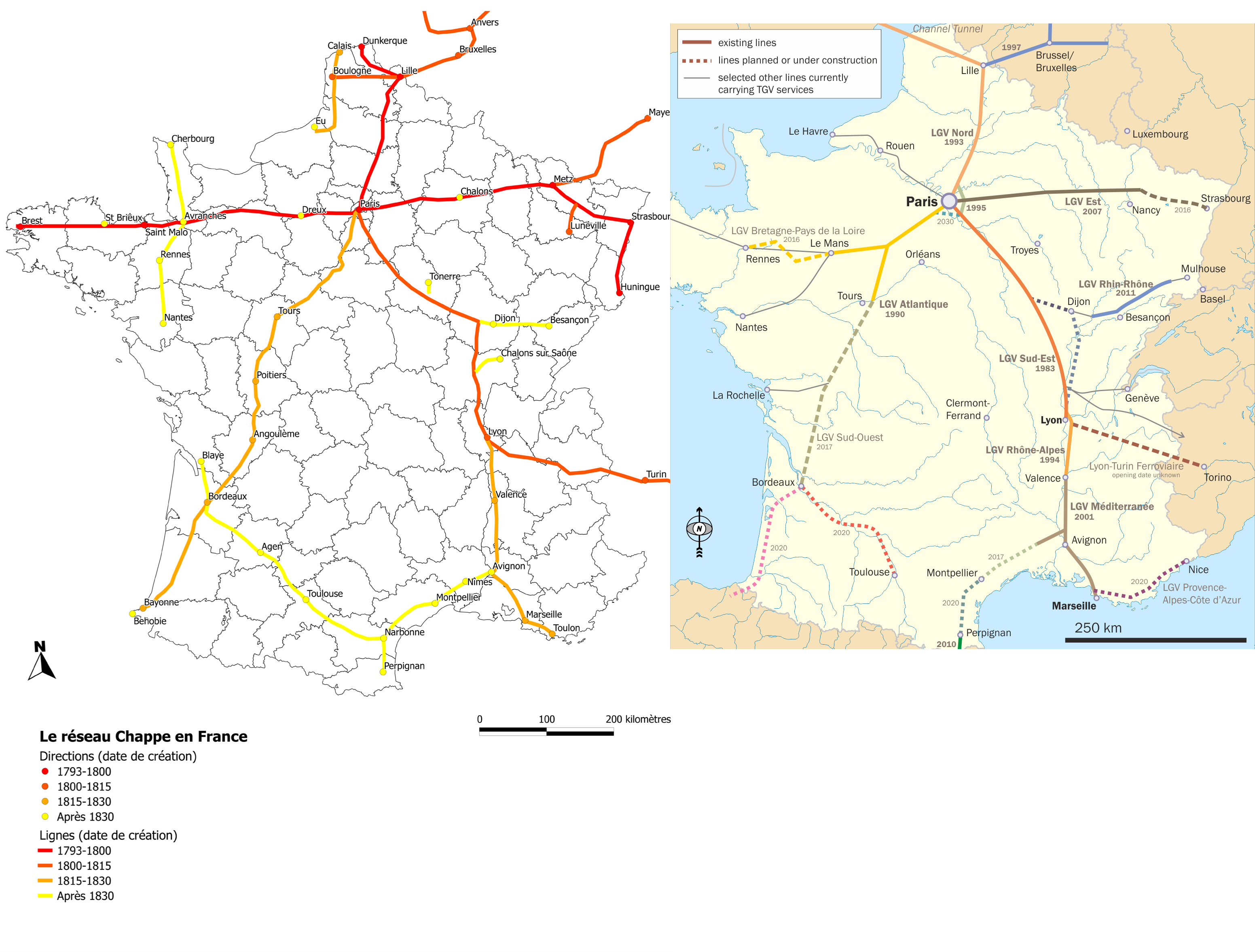
(It seems any large network in France takes 40 years to build.)
Telegraph systems were built extraordinarily quickly around the work, and in 1850, the first cable was laid across the English Channel (though it got cut by fishermen the night after it was completed). After failures in 1858 and 1865, a cable crossed the Atlantic in 1866.
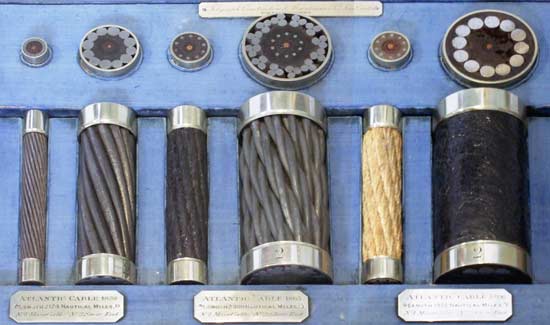
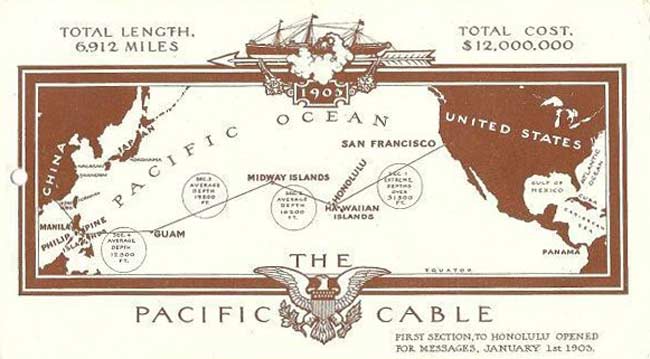
A fascinating account of the first transatlantic cable is covered at atlantic-cable.com, along with the trans-Pacific cable that landed in San Francisco in 1902.
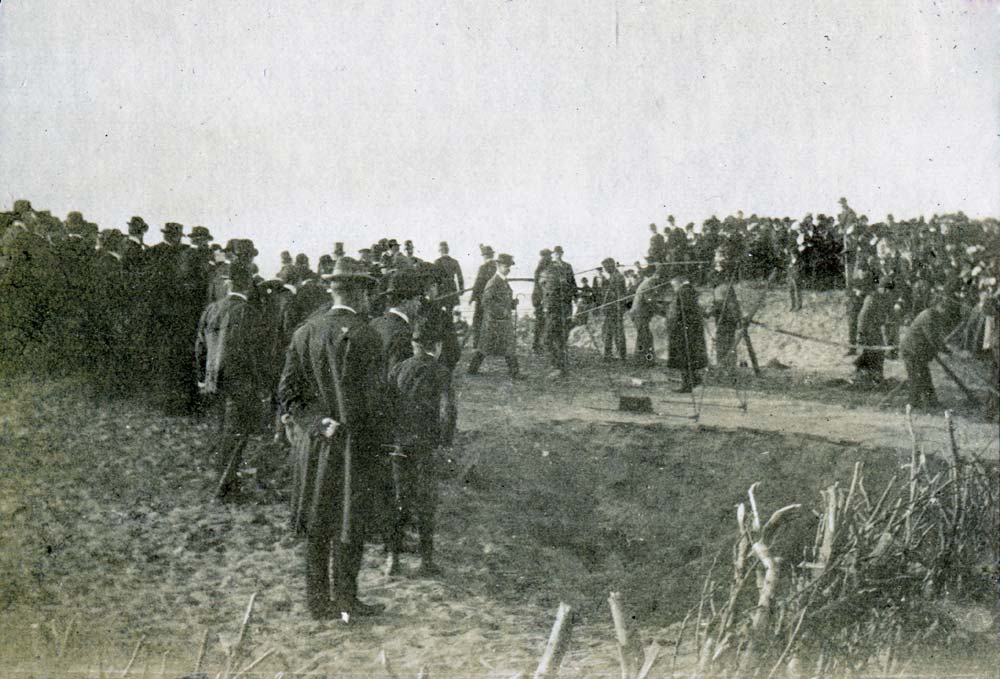
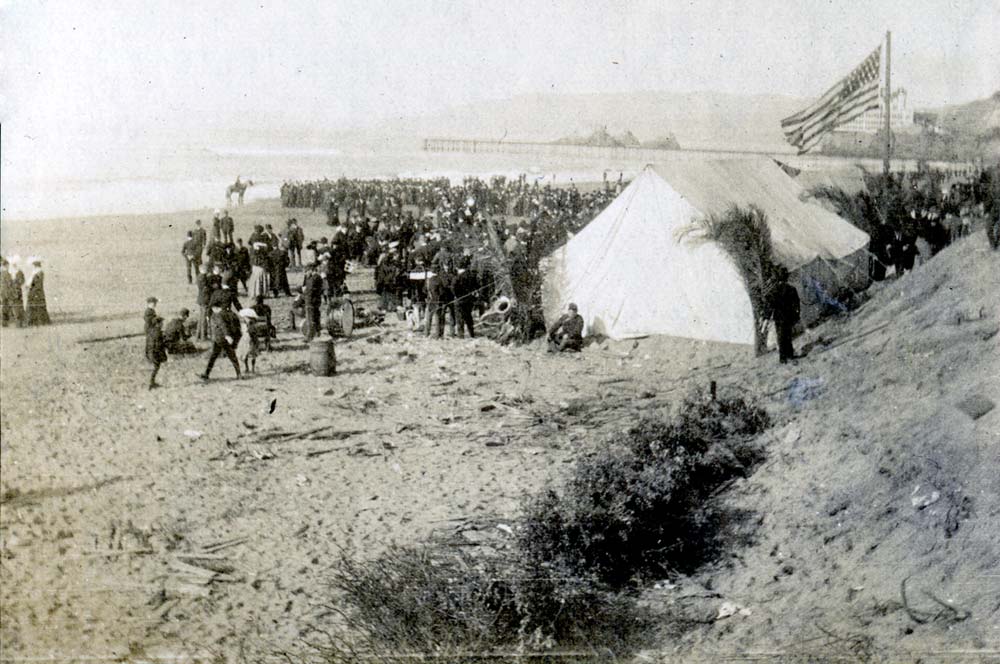
Also via atlantic-cable.com, guys in hats standing on Ocean Beach (near Fulton):
(If you’ve made it this far into the post, you really ought to read Tom Standage’s “The Victorian Internet”, for it, like he, is awesome.)
The Pacific Cable was big in Japan.
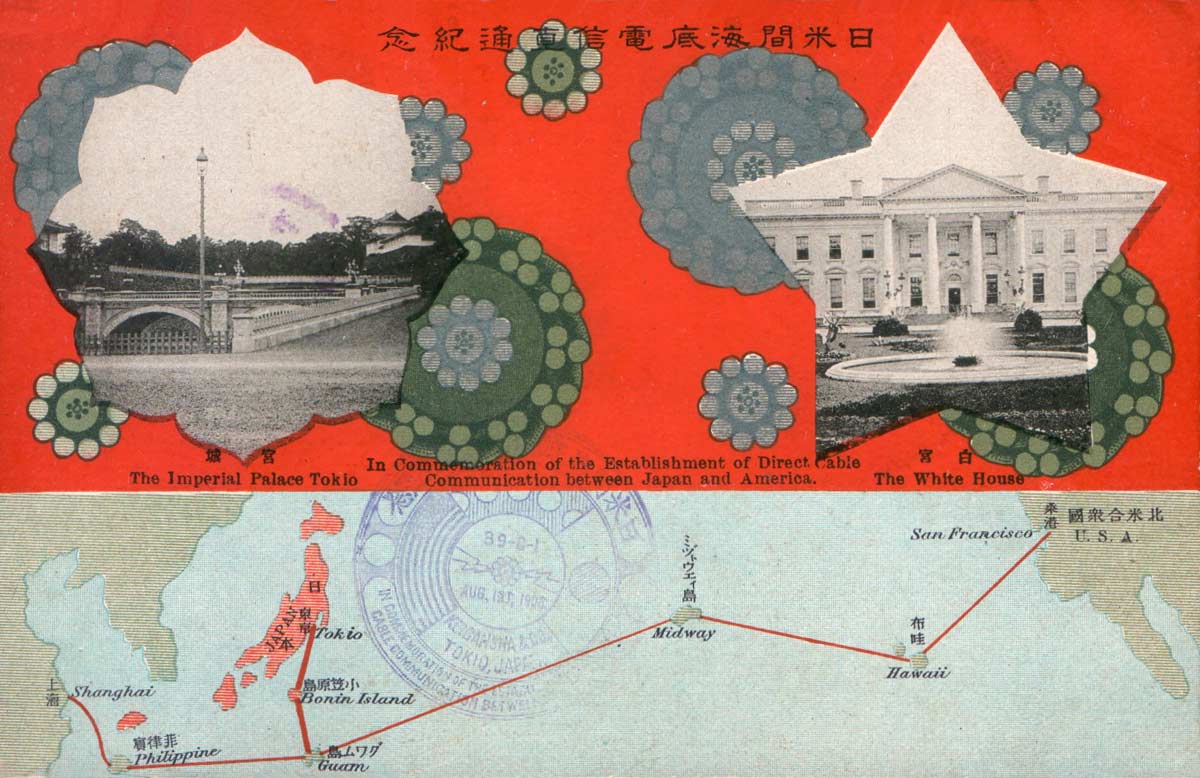
A little research and adjustment for inflation shows that it cost FIFTY OR MORE DOLLARS A WORD to send a telegram from Osaka to San Francisco in 1903.
Think of that when you Skype your buddies overseas.
Side note: I was surprised to see that San Francisco was written in kanji on the map above.
“Foreign” places are typically written in katakana, e.g.
サンフランシスコ
but on this map it’s written as “Mulberry Harbor”.
桑港
Turns out that’s from an old Chinese transliteration of SF:
Since you’re asking, SF has been written as “old gold mountain” in Chinese since the Gold Rush.
旧金山
Anyway, this naturally leads to one of my favorite subjects, telecommunications networks taken out by animals. Eventually, fiber optic undersea cables replaced copper. But to the surprise of engineers and executives, SHARKS STARTED EATING THE CABLES. Said the New York Times in 1987:
Sharks have shown an inexplicable taste for the new fiber-optic cables that are being strung along the ocean floor linking the United States, Europe and Japan, telephone company officials say.
In the Atlantic alone, shark bites have caused the failure of four segments of cable, which is the main artery for global voice and computer communications. And British telephone officials monitoring the installation of the fiber-optic network that will link the United States to Japan and Guam are also reporting troubles with gnawing sharks.
The attacks have caused some delays in laying cable, and a single bite on a deep-sea line, which is about the size of a garden hose, can cost $250,000 or more to fix. There is a benefit, however. In studying ways to limit damage from the attacks, the telephone companies are providing marine scientists with valuable new data on sharks and specimens of previously unknown species.
The first evidence of sharks’ attraction to the cables was the discovery of shark teeth embedded in an experimental line off the Canary Islands in 1985. A shark usually loses teeth when it bites something, and it later grows new ones.
”We were surprised,” said James M. Barrett, deputy director of international engineering for the American Telephone and Telegraph Company. ”We had laid 55,000 or 60,000 miles of undersea cable all over the world with no problem. There had not been a single case of a shark biting one of the old cables,” which were made of copper.
An undersea fiber optic line uses a series of repeaters/boosters. Apparently the sharks are able to detect the electromagnetic field emitted by this line.
Also, the fiber optic cables are much thinner than the old copper cables, making for quite the shark-sized snack.
Don’t believe me? Well, here’s a video OF A SHARK BITING A SUBMARINE CABLE.
And you thought squirrels were bad.
Inside Out Valencia
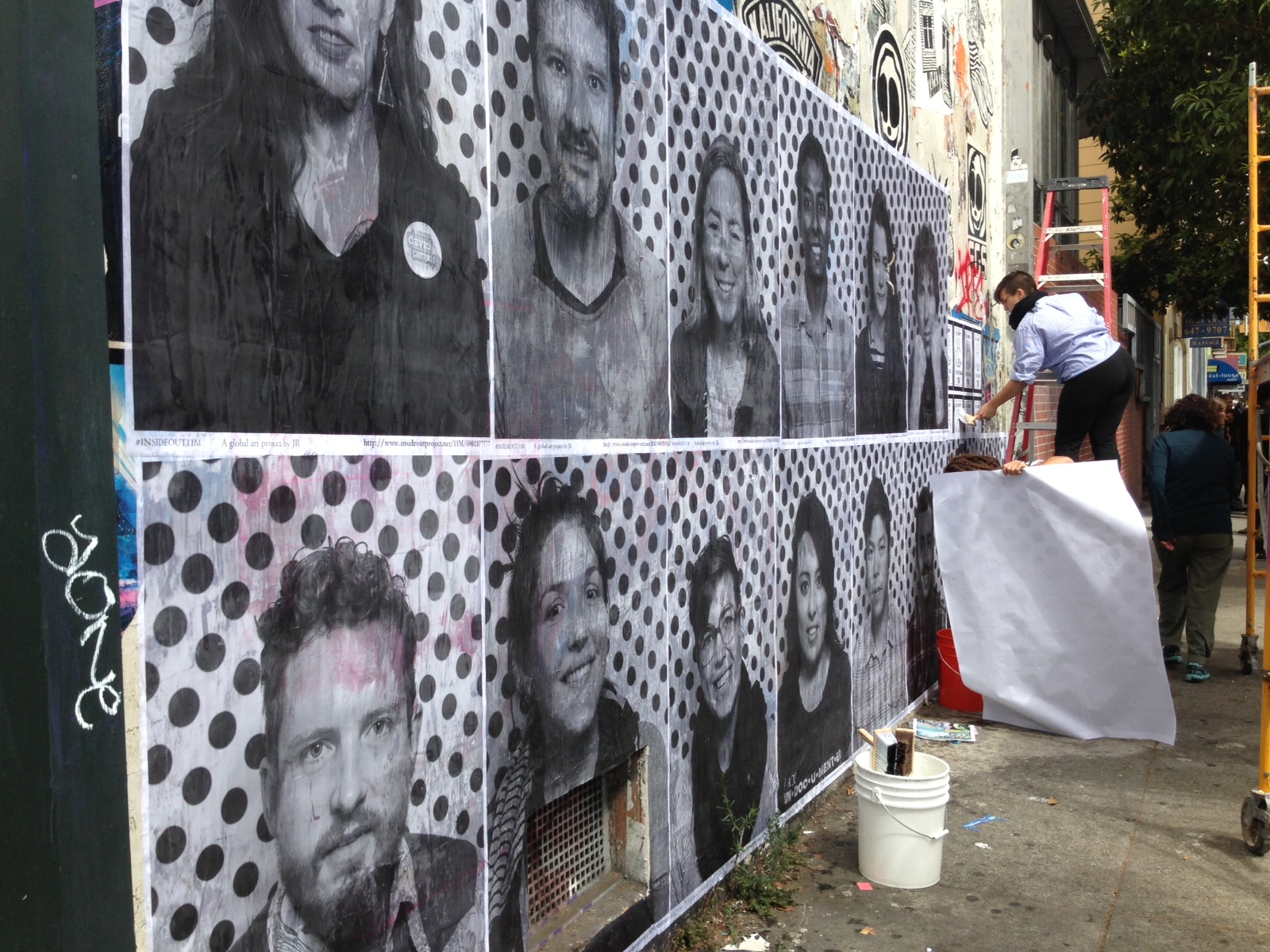
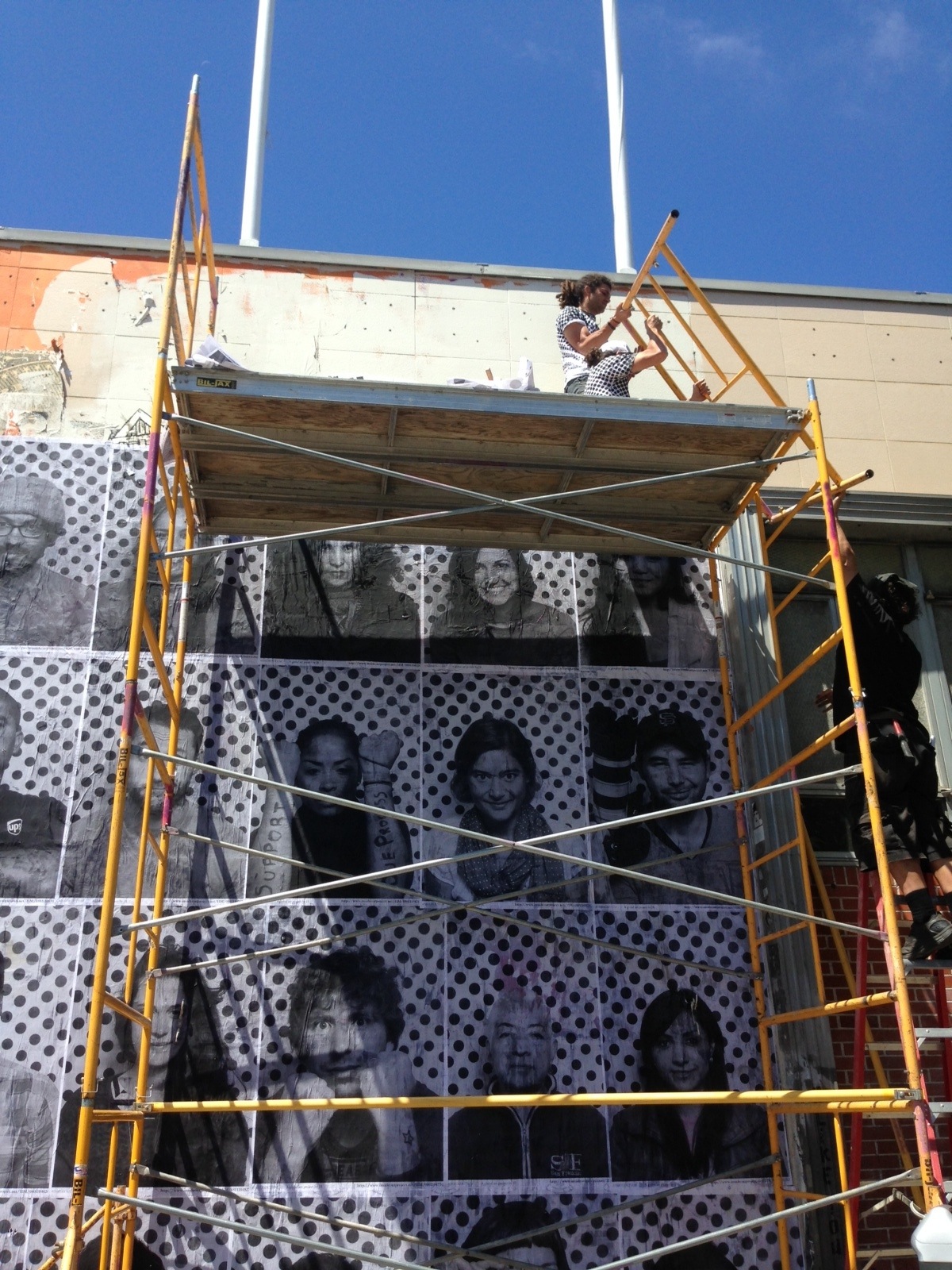
JR and Inside Out are taking and pasting giant portraits from a photo booth truck around SF this week (including the Valencia Street Art Wall from 10-12) in support of immigration reform.

UPDATE: live at the Valencia Street Art Wall: