Fleets Beneath The Waves
I’ve been following various “World War II + 70 years” blogs and twitter feeds with great interest. Watching these historical events play out bit by bit leaves you with a much different and more nuanced impression that the post-facto “I know how it ends” history we were fed in school.
World War II Day by Day has short summaries of each day’s air, sea and land battles, along with fascinating tidbits. (The Battle of Britain Day by Day blog was also very well done. It’s now “over”, but it will be rerun next year.)
While at this “point” in the war the Germans had given up the air in the Battle of Britain (Airminded is covering the mutual bombing campaign over Europe) the Battle for the Atlantic was well underway. The amount of British shipping sunk by German U-boats is simply astonishing. Survivors were often picked up in lifeboats days if not weeks after their ships were sunk, and were dropped off half way around the world. Sometimes the rescuing ship was sunk shortly after picking up survivors.
And I’m constantly shocked by the damage that armed German merchantmen did in the Pacific. The German raider Komet passed through the Arctic in the summer of 1940 (with the help of Soviet icebreakers) and spent 1940-1941 sinking 40,000 tons of shipping while disguised as Japanese and Soviet freighters. In Nov 19 1940, the Pinguin sunk a refrigerated freighter heading from Australia to Britain. The crew was taken prisoner, but 16 million eggs sank to the bottom of the Indian Ocean. The next day, the Penguin attacked and sank another freighter taking food to England. More prisoners were taken aboard, but the “Pinguin’s First Officer returns to the burning ship to get clothes for the women, who are in their nightgowns.” The ship sunk, taking 5000 pounds of meat, wool, butter and cheese with it.
The Orwell Trust is publishing George Orwell’s war-era diary + 70 years –it’s hit or miss, as it includes how many eggs his chickens laid — but the buildup to the war is interesting, and the Trust links Orwell’s references to daily newspaper articles to the scanned newspaper archives themselves.
One graphic example was the the Daily Telegraph’s scale diagram of the British battle fleet in 1939 on the eve of war:
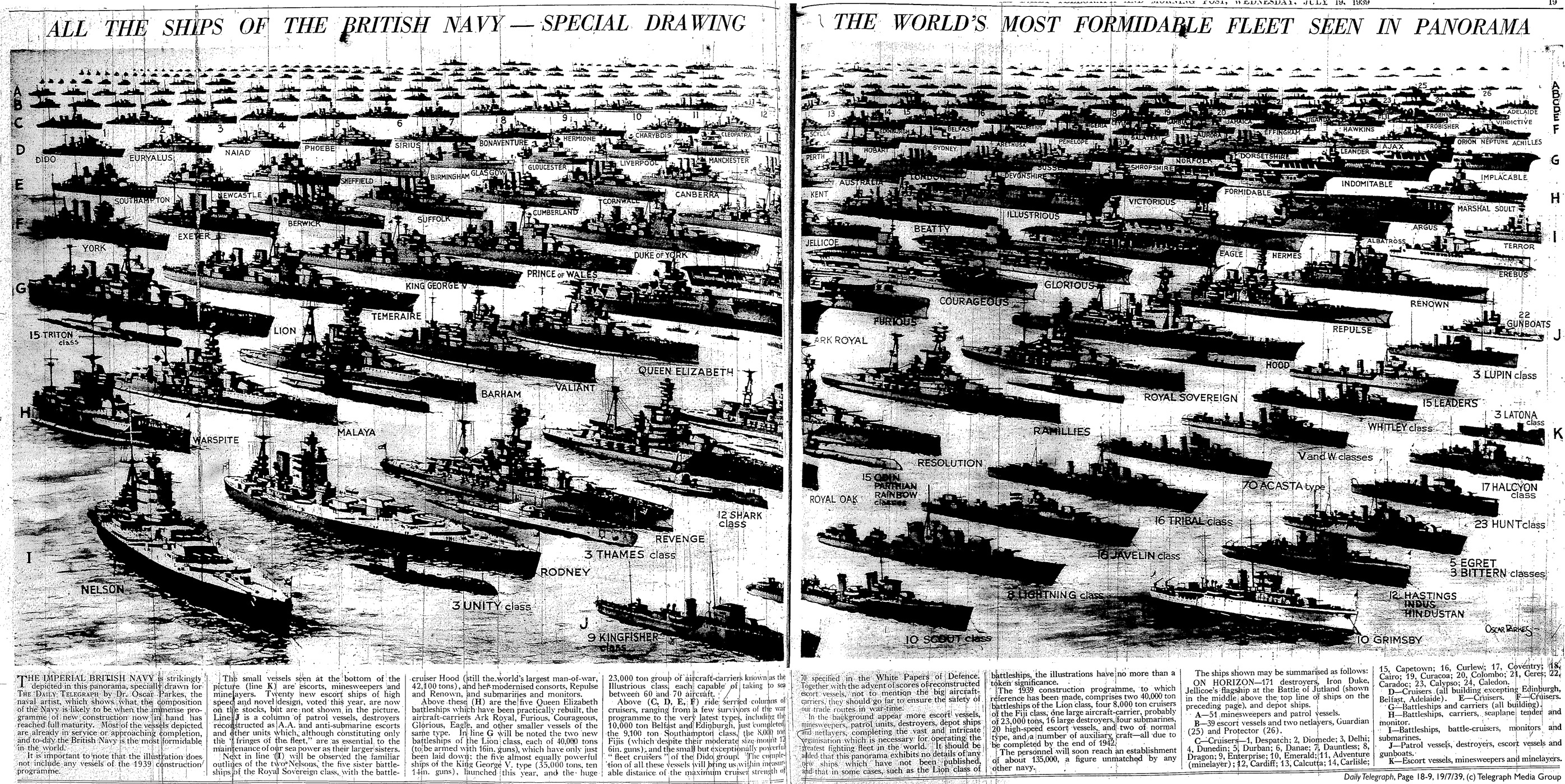
I did a little digging and figured out which ships were sunk during the war, when and where.

My grandmother told me how stunned the British Empire was when the Hood was sunk in 1941. Churchill’s “Sink the Bismark” was no joke. Check out the WWII DbD blog this coming May for the play-by-play.
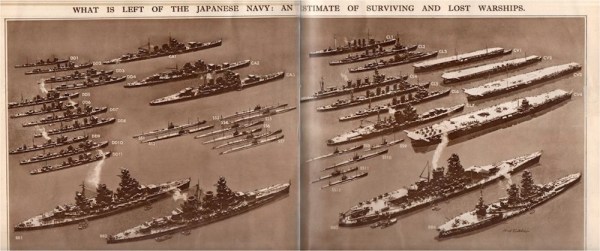
Ptak Science Books (a fantastic resource for charts, maps, diagrams and historical analysis) points to a few more naval fleet comparisons, including this analysis of the Japanese fleet that survived WWII.
Ships sunk by class:

On a lighter war note — when Italy invaded Greece in late 1940, it didn’t go very well for the Italians. The Greeks counterattacked and quickly pushed the Italian army back into Albania.
Soon after, in the French Riviera, someone from put up a sign near the Italian border:
“This is French territory. Greeks, do not advance any further.”
From Sutro to Shining Sutro
Froze my ass off Sunday when it was surprisingly sunny and I foolishly thought it wouldn’t be that windy on top of Twin Peaks. (Hint: very windy.) But hey, got a decent Sutro to Sutro panorama from the top of the north peak. (Click to zoom, 7000 pixels wide)

(The panorama got a little wonky pointing towards the sun — I was blinded and struggling to keep my balance thanks to the 30 mph gusts (the lengths I go for art). Anyway, the east side of the south peak got cut off, whoops, but it was cold. But if you zoom in you can see the crazy bastard who was sitting up there the entire time.
Hey, did you know that the south peak is supposedly called “Noe Peak” and the north is “Eureka Peak”? Me neither.
Hey, did you also know that the two peaks are actually different types of rocks? The north peak is our old friend Franciscan Complex chert (Early Cretaceous and (or) Late Jurassic) and south is Franciscan Complex volcanic rocks (Jurassic). (But don’t worry, the very very top of the south peak is chert. GO CHERT!)
View from the top (north up). Red is chert, purple is Franciscan Complex Volcanic (hey, good name for a band!)

And from the view most familiar to most readers, looking to the west:

(And now we know why the Spanish called them Los Pechos de la Chola.)
Here’s hte USGS Google Earth geological layer and key.
Another shot got both towers of the Golden Gate Bridge fully lit (i.e. not shaded by a cloud).


Nice (though this is obviously a better shot).
UPDATE:
So it has come to my attention that the individual names for each Twin Peak, are, well, rather uninspiring. My initial thoughts:
- “Giants Peak” and “Seals Peak”
- “BART Peak” and “Muni Peak”
- “Gavin Peak” and “Willie Peak”
(OK, maybe not those last pairs.)
Please add your suggestions to the comments, and I will make a poll when we get a critical mass of names.
Street Inflation
We Built This City is on a freakin’ TEAR this month.
WBTC brings us Fillmore Discount Name Fail: “National Dollar: Everything’s $1.25”

Hey, with deflation, maybe we’ll get our Dollar Stores back! Wait, inflation’s actually good — in that it encourages people to spend money rather than hoard. Viva the $1.25 store! (as long as it doesn’t turn into Weimar wheelbarrows…)
Of course, this leads to the question — at what point did inflation cause a dollar store to resonate in society? References to 1960s prices in Mad Men are probably the greatest cause of hits on inflation calculators in all of history. Over the course of say 50 years, a dollar stopped being a lot of money, then was a good value, but soon started seeming cheap. My guess was the 70s.
We have evidence of this from the history of the Mission! (Big surprise, I know). Look to the right of this 1970 shot (SFPL) of the Grand Theatre — it’s an 88 cent store!

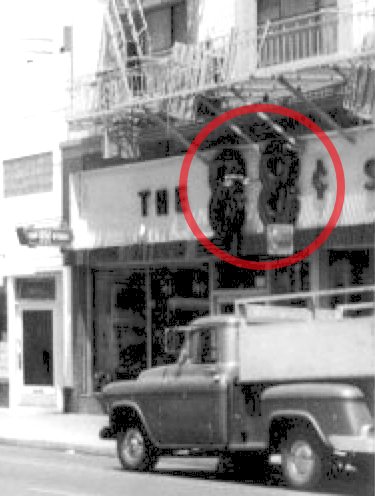
88¢ in 1970 is nearly $5 today! Where’s my $5 store, dammit? (Of course, let’s remember that Doc Brown gave Marty McFly $50 to buy a Pepsi in 2015, so the Fed seems to be keeping inflation under decent control all things considered.)
Summary view of the Grand and its neighbors in 1970, 2007, 2010. Until a few years ago, the Grand Theater was the “China Bazaar Wholesale“, while the former home of 88¢ delights is a video game store.

And in what I can now only call historical and economic fate, the Grand Theater is now ONE $ ONLY! (Well, I suspect the goods are $1, not the entire building.)
Philip, The Once and Future Clipper King
I checked out the the wreck of King Phillip sticking its bow once again above Ocean Beach yesterday (75 and sunny in November didn’t hurt).
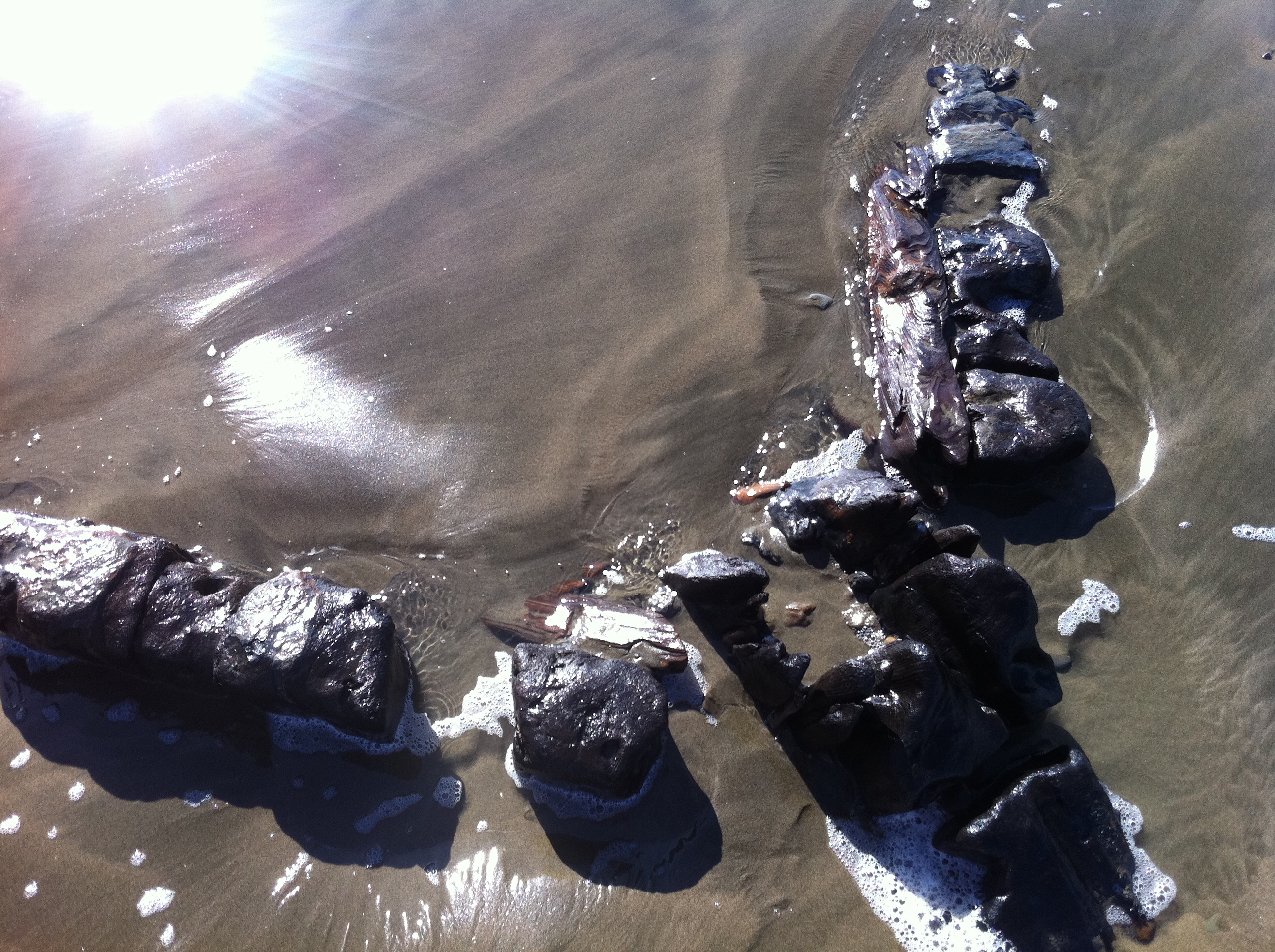
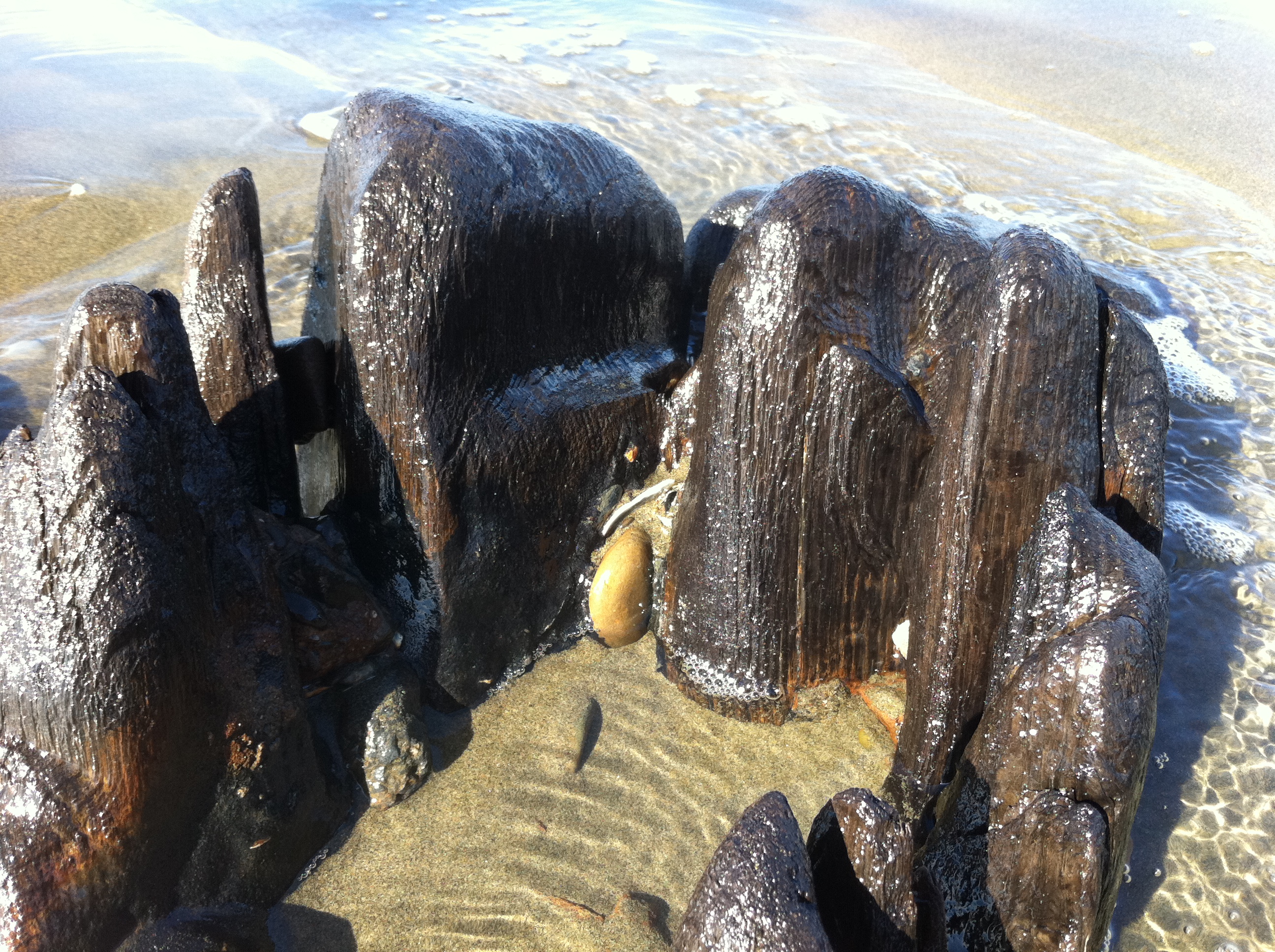
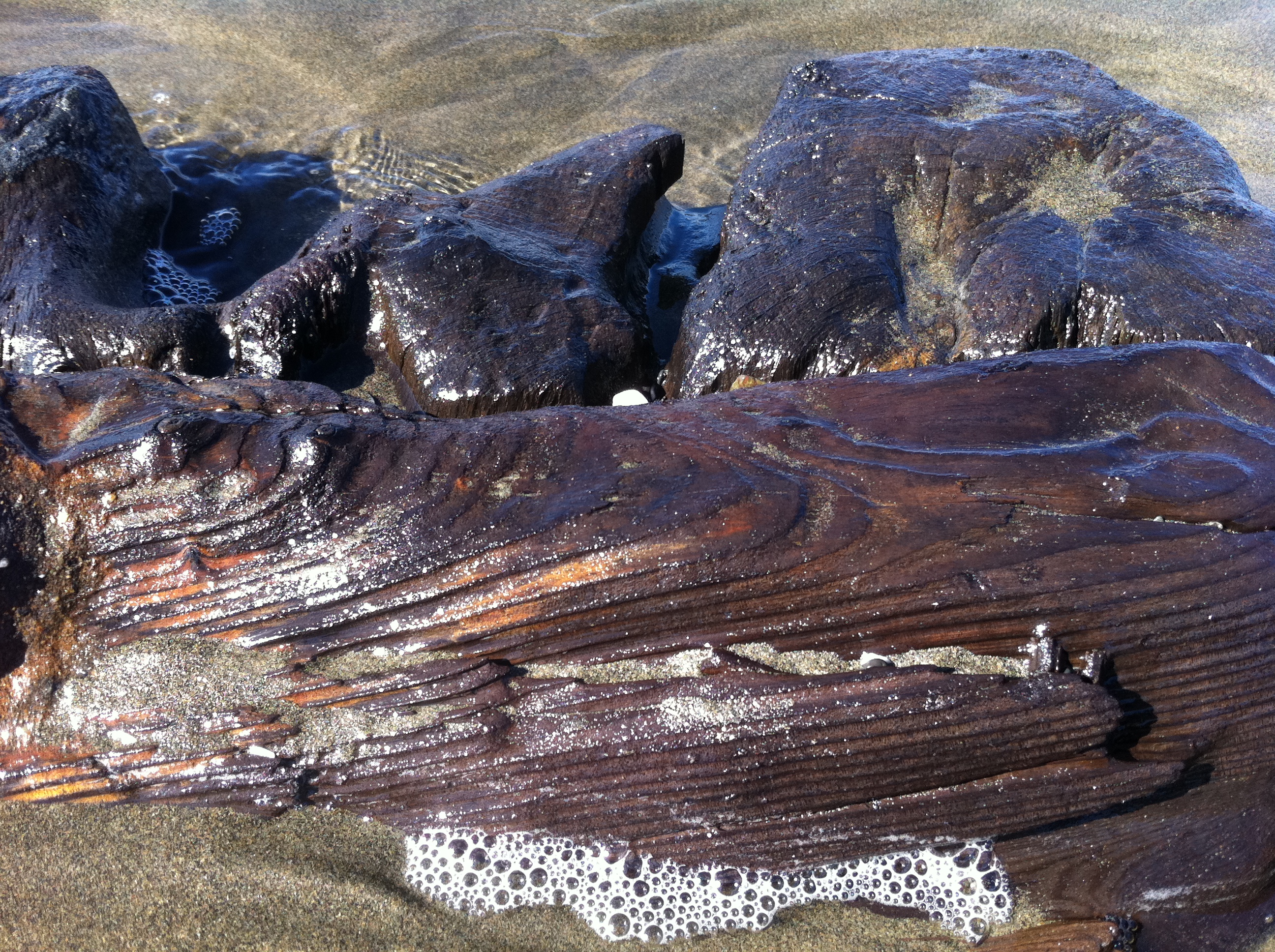
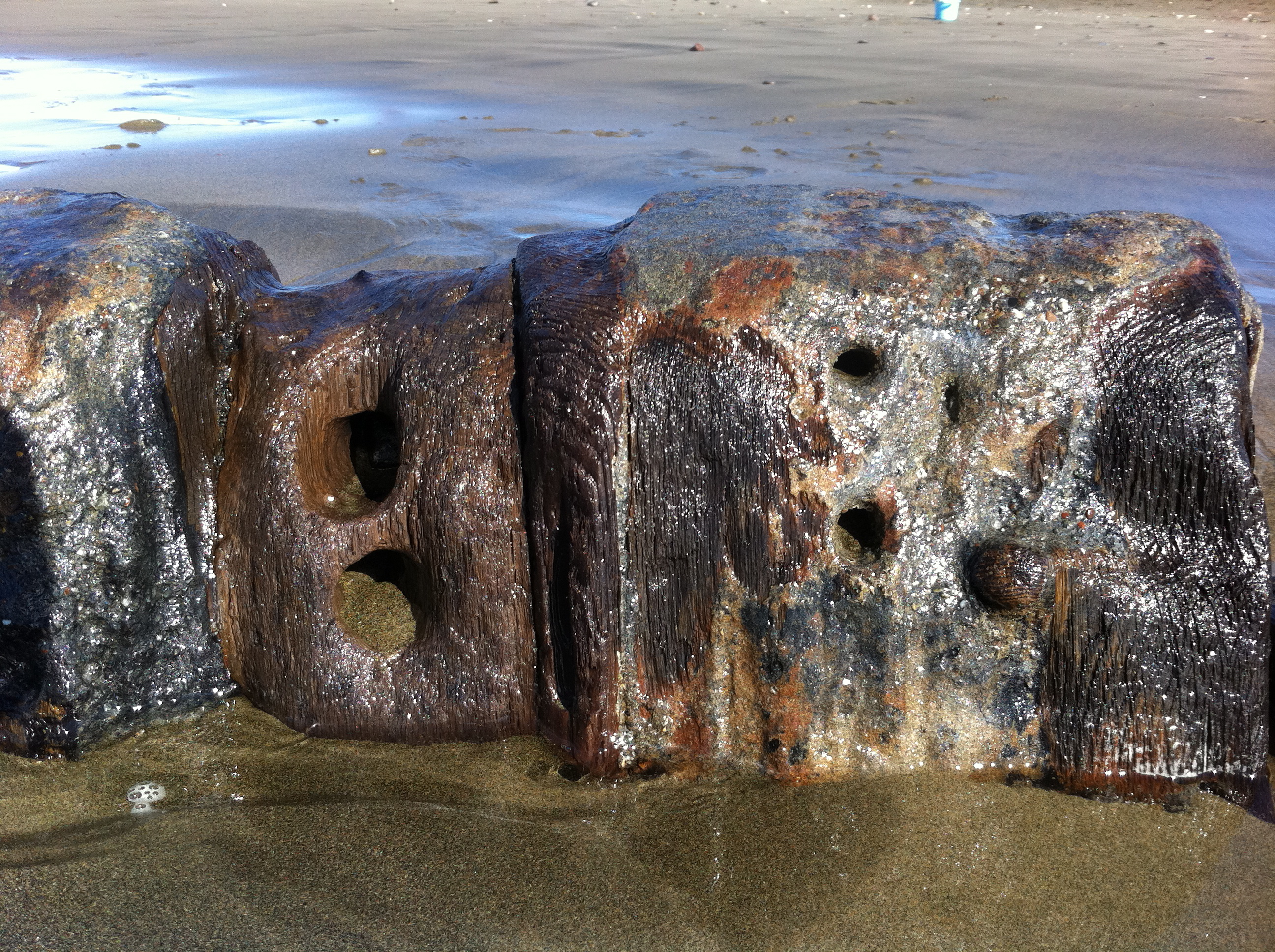
I did a little research and figured out most of the captains of the King Philip (details towards the end of this article):
- King Philip built and launched in 1856/7 in Maine
- Captain Norris, 1857? – 1859
- Captain Rollins, 1859 – 1860
- Captain John L. Bickford, 1860 – 1867
- Captain Hubbard, 1867 – 1869 (mutiny)
- Captain Black, 1869 – 1870
- Captain Daly, 1870 – 1873
- Captain Rawlins, 1873 – 1875 (mutiny, 1874)
- Captain Keller, 1875 – 1878
In the last showing in 2007, much more of the old clipper ship was visible, and in 1980, yet more. Here are some shots from (relatively) the same angle:
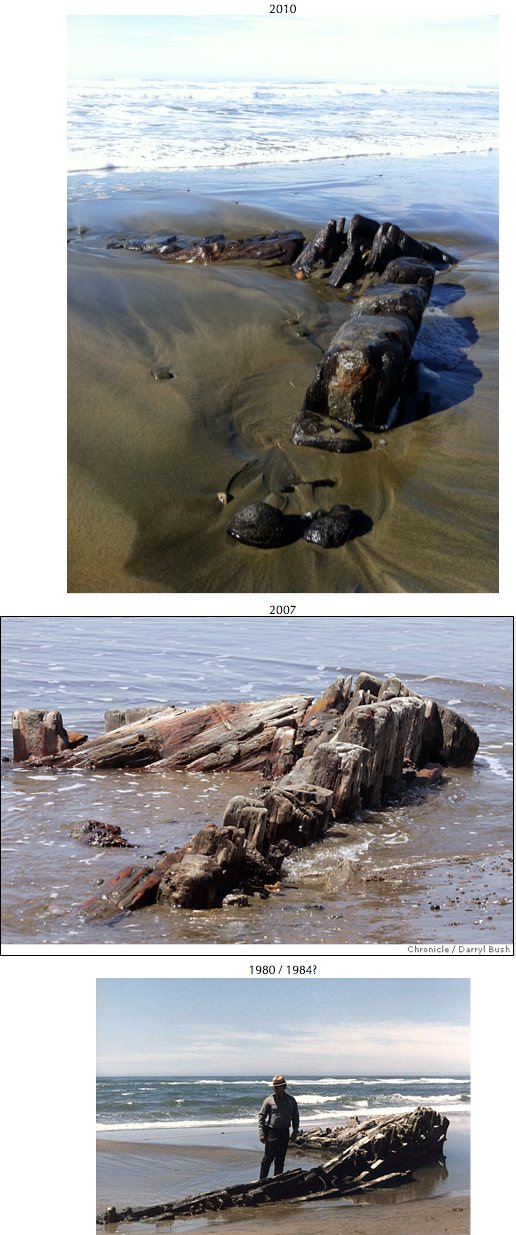
(2010 by me, 2007 by the SFgate, and 1980/1984 I believe by the Chronicle.)
The old metal pipe has snapped off in the past 3 years:
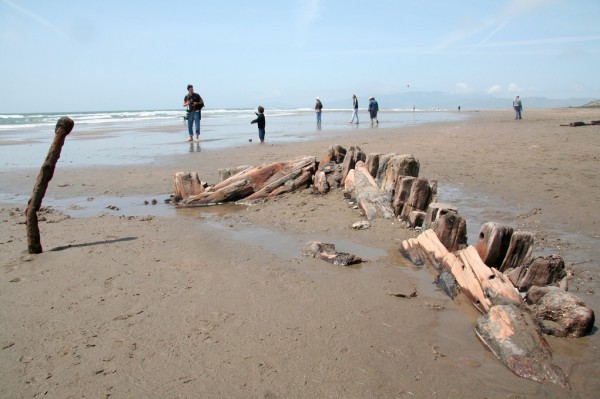
(2007, Flickr, AlmostJaded)
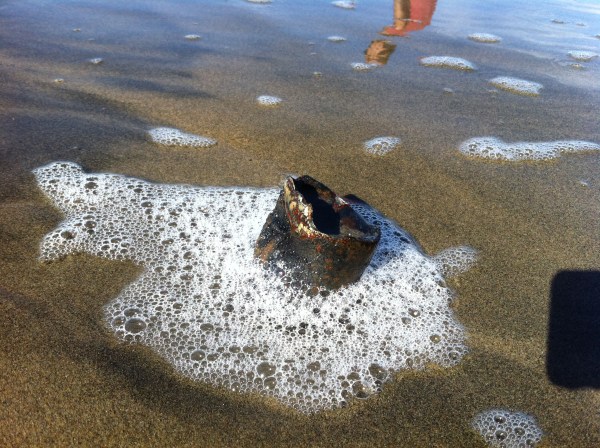
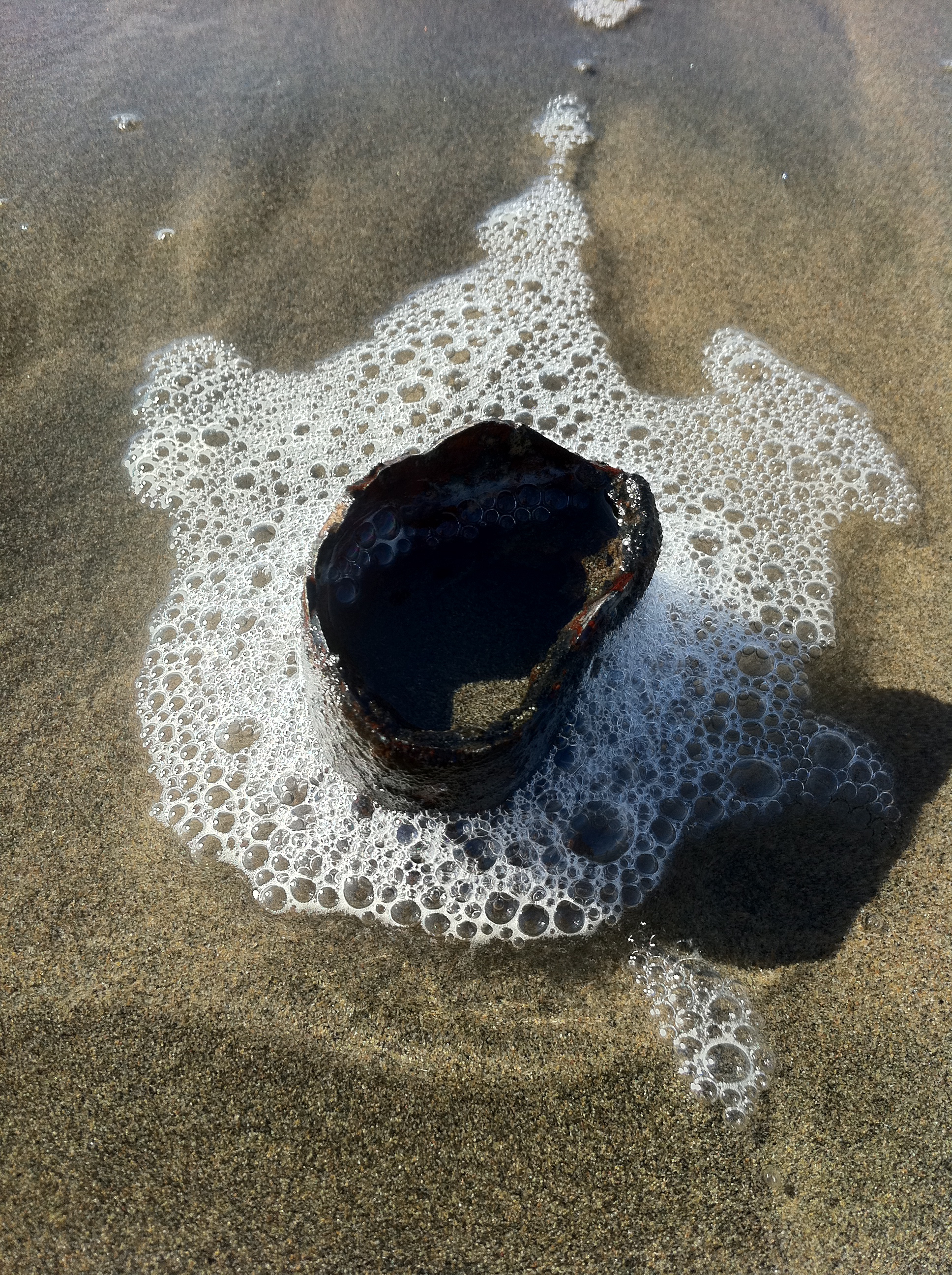
(2010, me)
2007 summaries of the wreck at Not Yet Melted, Bloody Marys for Brunch, SFist and SFGate.
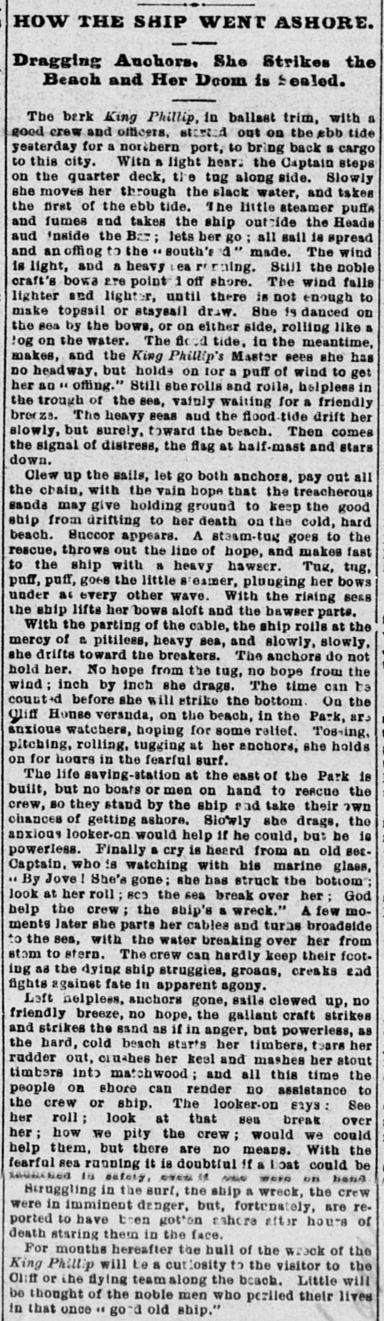
Dialing back the time machine, here’s the account of the 1878 wreck from the Daily Alta:
“Left helpless, anchors gone, sails clewed up, no friendly breeze, no hope, the gallant craft strikes and strikes the craft as if in anger, but powerless, as the hard, cold beach starts her timbers, tears her rudder out, crushes her keel and mashes her stout timbers in matchwood…”


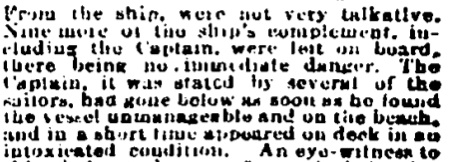
However, there was some controversy — the Chronicle reports that “the captain, it was stated by several of the sailors, had gone down below as soon as he found the vessel unmanageable on the beach, and in a short time appeared on deck in an intoxicated condition.” (SFPL card required.)
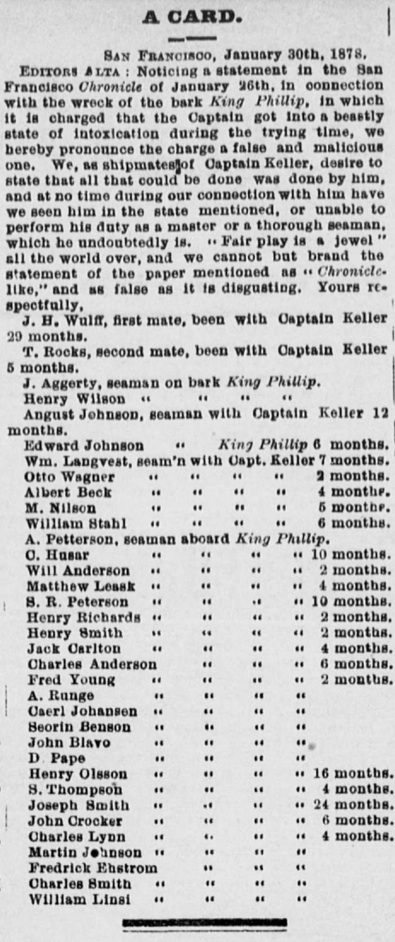
The crew of the King Phillip wrote a strong letter to the editor of the Daily Alta in response, none to happy with the Chronicle’s accusations:
“at no time in our connection with him have we seen him in the state mentioned… we cannot brand the statement of the paper mentioned as “Chronicle-like” and as false as it is disgusting.”
A few days later the Daily Alta reported that Captain Keller had gotten a new job:
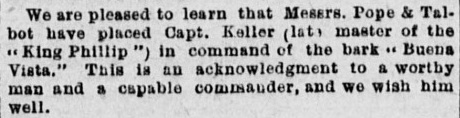
No signs of Captain Keller outside of the incident. (For those of you searching online, I will save you a little time — the Daily Alta records the name of the ship as the “King Phillip” while the Chronicle uses one L, “King Philip”)
According to the Chronicle, the King Phillip had just left Hunter’s Point Drydock 8 hours before (SFPL card required) with new sails and rigging, and other than the loss of the anchor and rudder (“considerable portions of the ship’s rudder were carried away by relic hunters”), was in good condition. In Decmber 1877, the 50 year old ship was valued at $20,000 (nearly half a million today) but the wreck was sold to Thomas Mallory for $1050 ($23,000 today).
I had heard that the hull of the King Phillip was blown up. But apparently it took several attempts:

Daily Alta, 24 Feb 1878, not so fast…
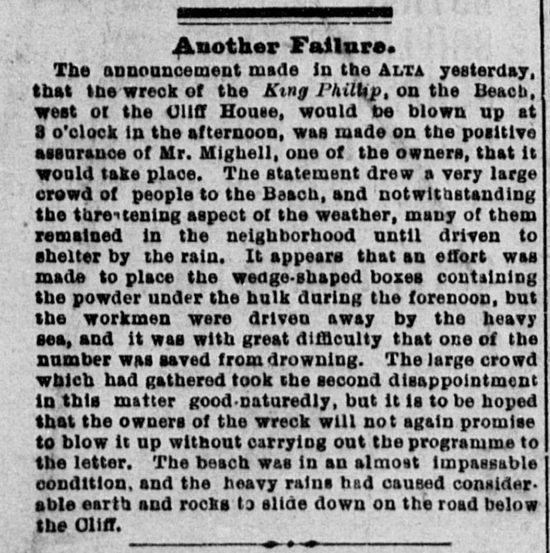
There was a second attempt and failure which I can’t find reference to. A third try was made on April 19, 1878:
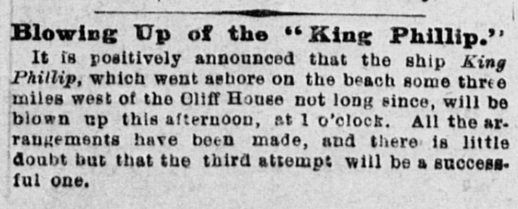
I couldn’t find a followup, but I have to wonder how well it worked given the condition of the hull in the 1980s when the bow, stern and ribs were above the sand.
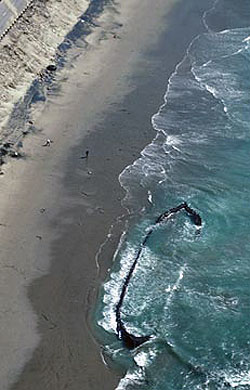

(NPS.gov, Chronicle)
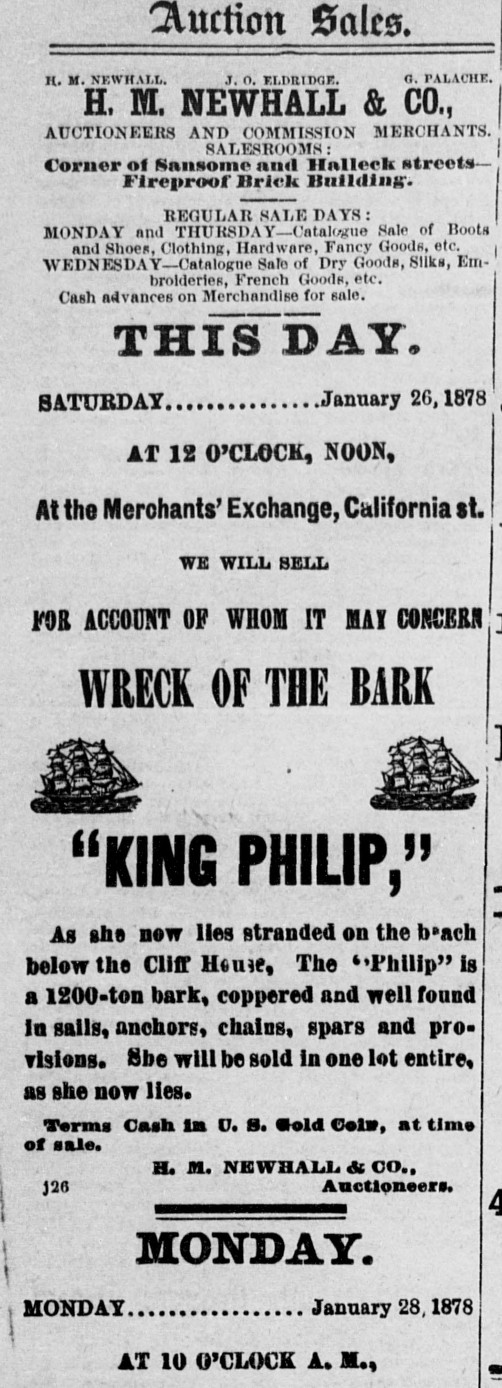
Interestingly, the day after the wreck in January, H.M. Newhall didn’t waste any time and announced an auction for the carcass of the King Philip:
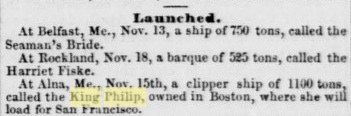
And the other end of the history bookshelf is the announcement of the launching of the King Philip after it was built in Maine in 1857:
Here’s what I believe is a manifest of the King Philip as it arrived in SF in 1859:
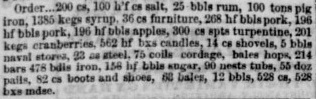
This is just the last few lines – seriously, take a look at the crazy long full list. Shoes, 8 barrels of whiskey, shoes, 5 cases of fireworks, shoes, 100 kegs of nails, shoes, 950 doors, 12 drums of fish, shoes, 3050 1/4 boxes of soap. Oh, and shoes. You think I’m kidding.
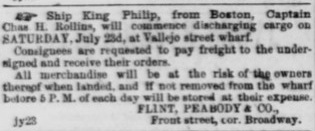
It looks like it was commanded by “Captain Rollins” in 1859, offloading on Vallejo street (pretty much where Pier 9 is today).
1859 Coast Survey detail of the wharves (Vallejo is up top).
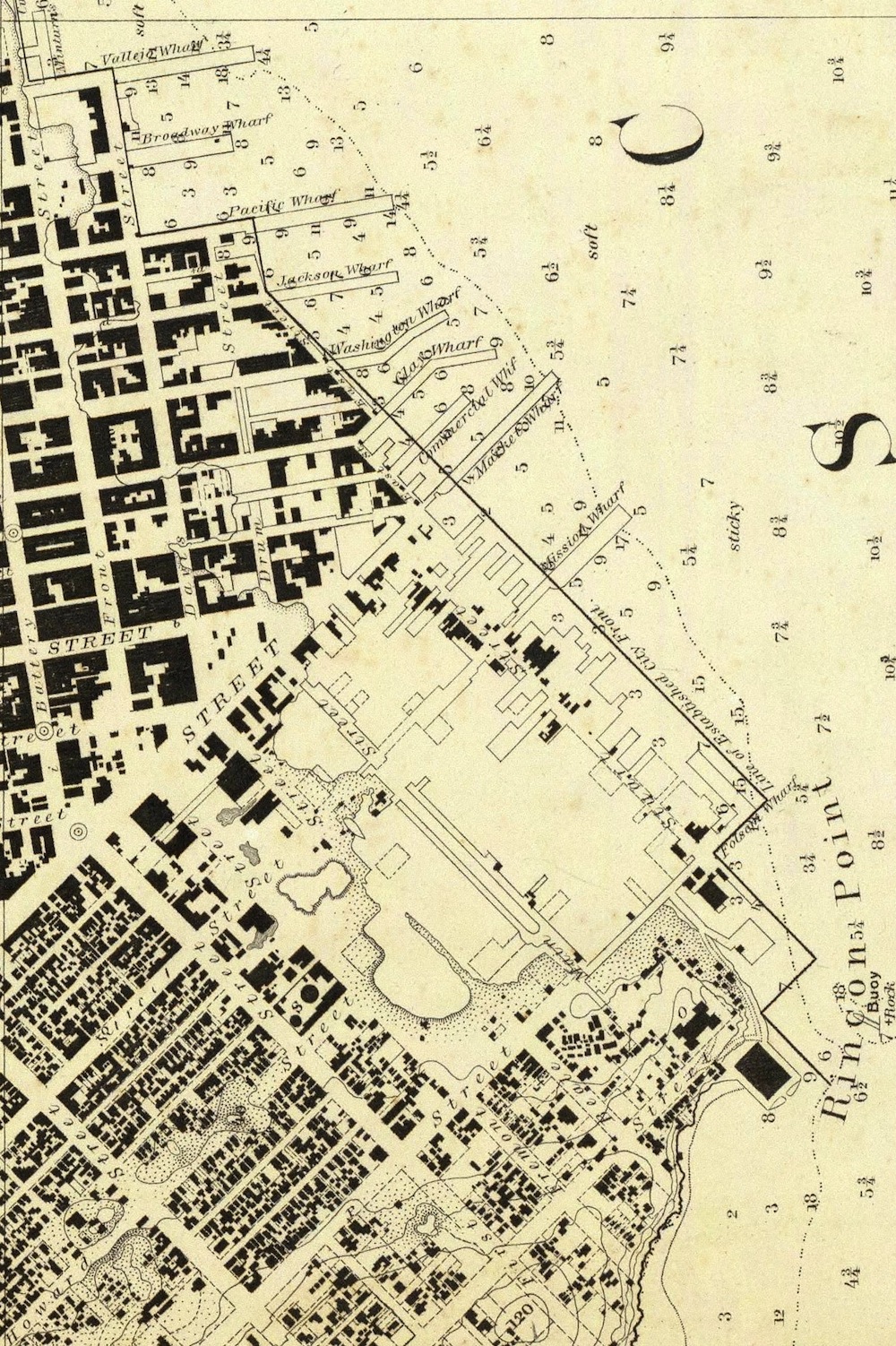
(Oh, for a picture of the wharves of that era. Check out that lagoon off of Market. Watch your step.)
Anyway, someone let me know if the rest of the ship pops up this time around — I only hit Ocean Beach if it breaks 70.
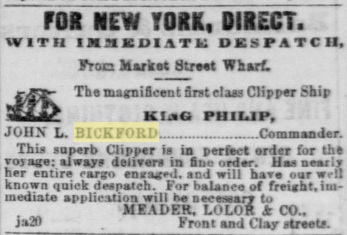
UPDATE: The esteemed nautical division over at LookBack Maps points us to this undated advertisement for the King Philip in earlier years, (via the Bancroft Library no less):
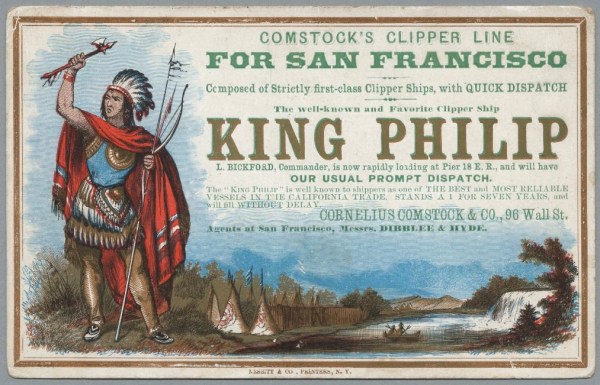
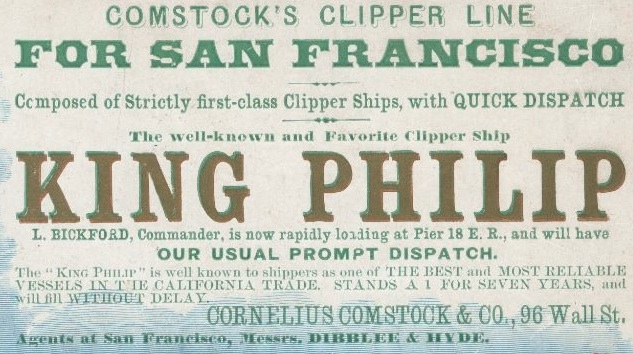
Hey, it’s Captain L. Bickford at the helm! Using various ancient yet advanced methods of searchfu, we find Captain Bickford at the helm of the King Philip in 1865.
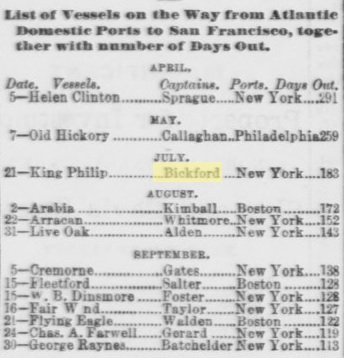
They docked at the Mission St. Wharf in those days. (See map above.)
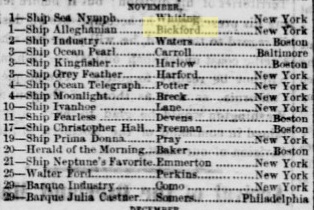
The earliest references to Captain Bickford are in 1858 and 1859 when he commanded the Alleghanian.
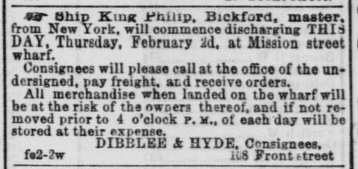
The last reference I find to Bickford is 24 Jan 1867, 11 years before the King Philip beached.
Unfortunately, we find another reference to Captain Bickford and the King Philip in September 1861:

This makes me really sad.
It seems Captain John Bickford commanded the King Phillip from about 1860 to 1867.
Afterwards, there was a quick succession of captains of one or two years: we had Captain Hubbard; then Captain Black; then Captain Daly.
There were two mutinies on the King Philip — one in Honolulu in 1869 [NYT] seemingly under Hubbard, where the ship was set on fire [Daily Alta], then another in Baltimore in 1874 [NYT], under a Captain Rawlins. There’s also reference to Captain Rawlins and the King Philip from 1875, three years before the Ocean Beach incident.
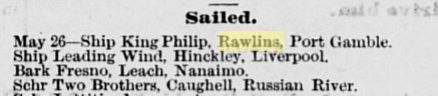
Rollins, Rawlins. Rawlins, Rollins. Captain, Captain. (15 years, and at least 6 captains.)
Captain Keller took command of the King Philip in July 1875. At this point it looks like our clipper ship was no longer doing the East Coast run, and was hauling lumber from Puget Sound.
I dug around to see what Captain Keller was doing before the King Philip. I can trace him to about 1860, but then things start to get confusing — there was another Captain Keller doing Hawaii and Hong Kong runs, and another doing Liverpool, and I doubt either is our man. A Captain Keller did sail a ship from Boston to Puget Sound with a sawmill in 1858, while our Captain Keller was sailing back and forth to Puget Sound every few weeks. But a Captain Keller associated with a saw mill in Puget Sound died in 1862. Oh, for a first initial.
| Puget Sound Capt. Keller |
Post King Philip Capt. Keller |
Some other Captain Keller (not ours) |
|---|---|---|
|
The last command for Captain Keller I can find is back on the Bark Arkwright. (Flows off the tongue, no?) I’m still not sure on the 1853 Susanito & Bolinas Bay date – that would be 38 years on the water. A few years before that as a shiphand, perhaps? Worst case it’s 1859 – 1891 or 32 years. No references for him in the city databases, sadly.
Imagine sailing up and down the West Coast every few weeks. (Saw some references to the trip taking 55 hours.) Interesting commute. I wonder if it was a company with a series of ships, or you negotiated each year with a ship owner?
Note from the crew’s testimony (up top) that Keller’s first mate, J. H. Wulff, served with him for two and half years as of Jan 1878 — they must have come on the ship together when Keller took command of the King Philip in July 1875.
It seems that Wulff got his own ship by 1880. The Rainier did the same Puget Sound run:
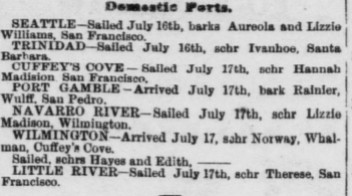
Could “Henry J. H. Wulff” be the same guy? He got married in 1889. Could be his son, I suppose? Or a late marriage — if we was a first mate in 1875, maybe he was born in 1850, and got married at 49 to a younger woman? Feasible but pushing it.

HJH and Annie had a daughter in 1898:

But lost a 10 year old son in 1901:
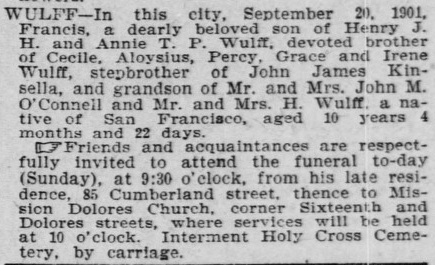
And got divorced in 1902:
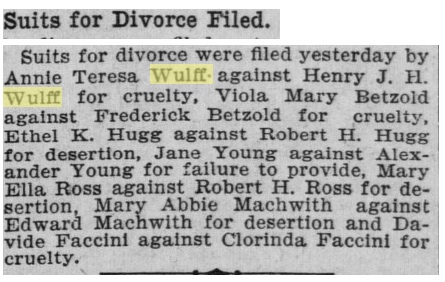
They lost another son in 1905.
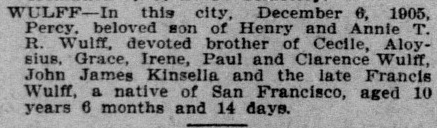
God this is getting depressing. I don’t know what’s more shocking, that they lost so many children, or that they had eight all together. Time to get back to the ship.
The last reference to the King Philip in regular shipping news is immediately before the wreck:
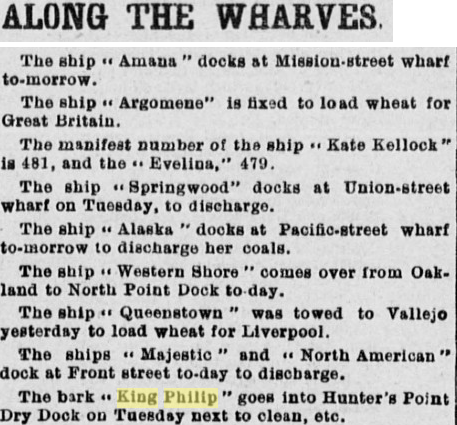
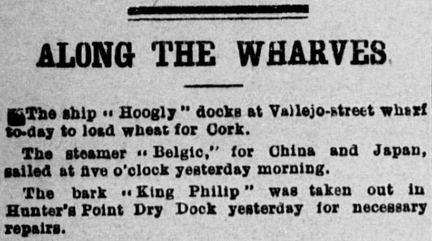
And then King Philip met Ocean Beach.
To summarize, Oh Captain My Captains:
- King Philip launched in 1856/7 in Maine
- Captain Norris, 1857? – 1859
- Captain Rollins, 1859 – 1860
- Captain John L. Bickford, 1860 – 1867
- Captain Hubbard, 1867 – 1869 (mutiny)
- Captain Black, 1869 – 1870
- Captain Daly, 1870 – 1873
- Captain Rawlins, 1873 – 1875 (mutiny, 1874)
- Captain Keller, 1875 – 1878
Holy crap, this got long. Such is your random history lesson for today. (Just for perspective, on the other side of the city in the 1870s, they were playing baseball in the Mission at Folsom and 25th.)
Beer Barrel Planter
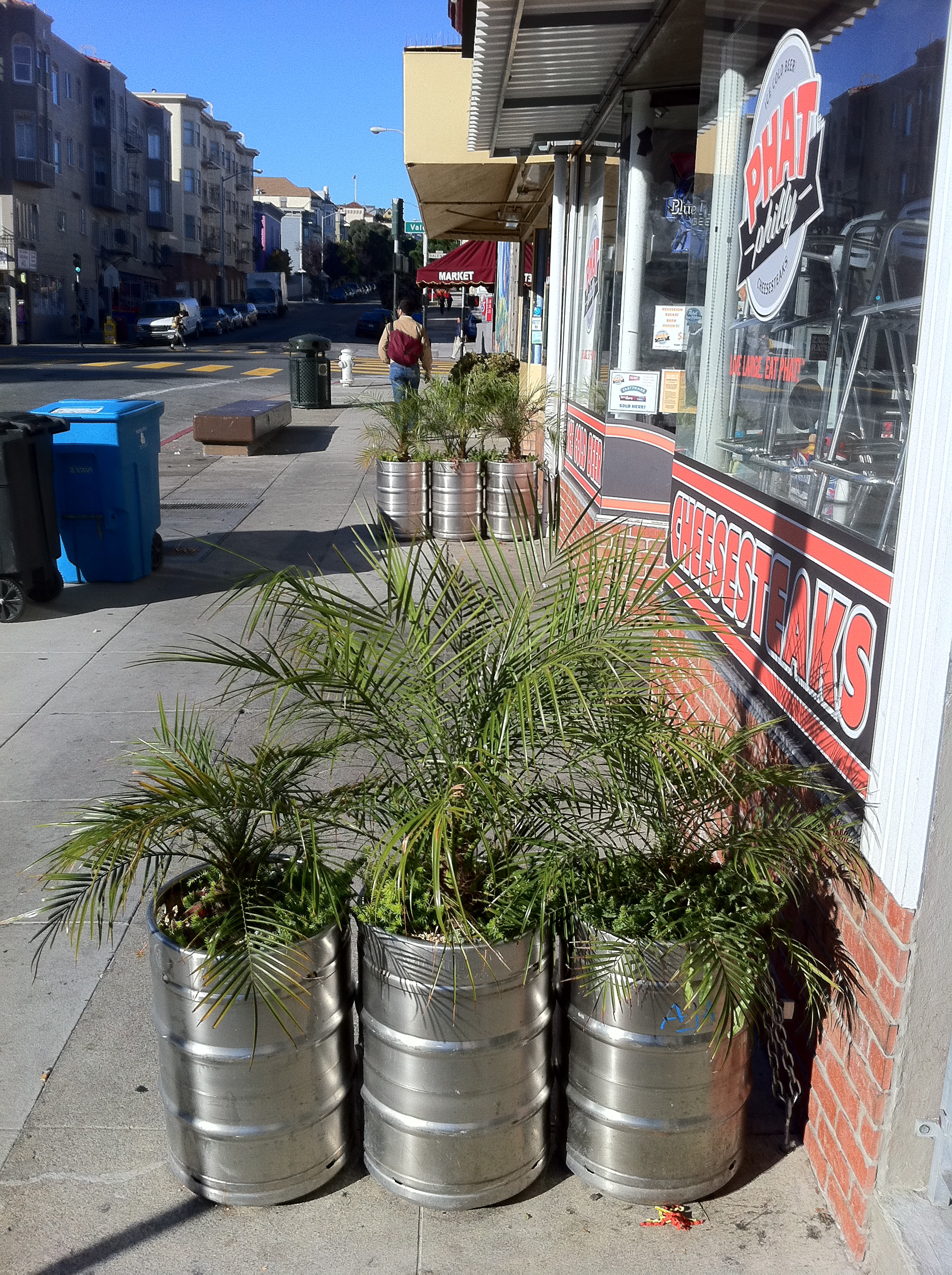
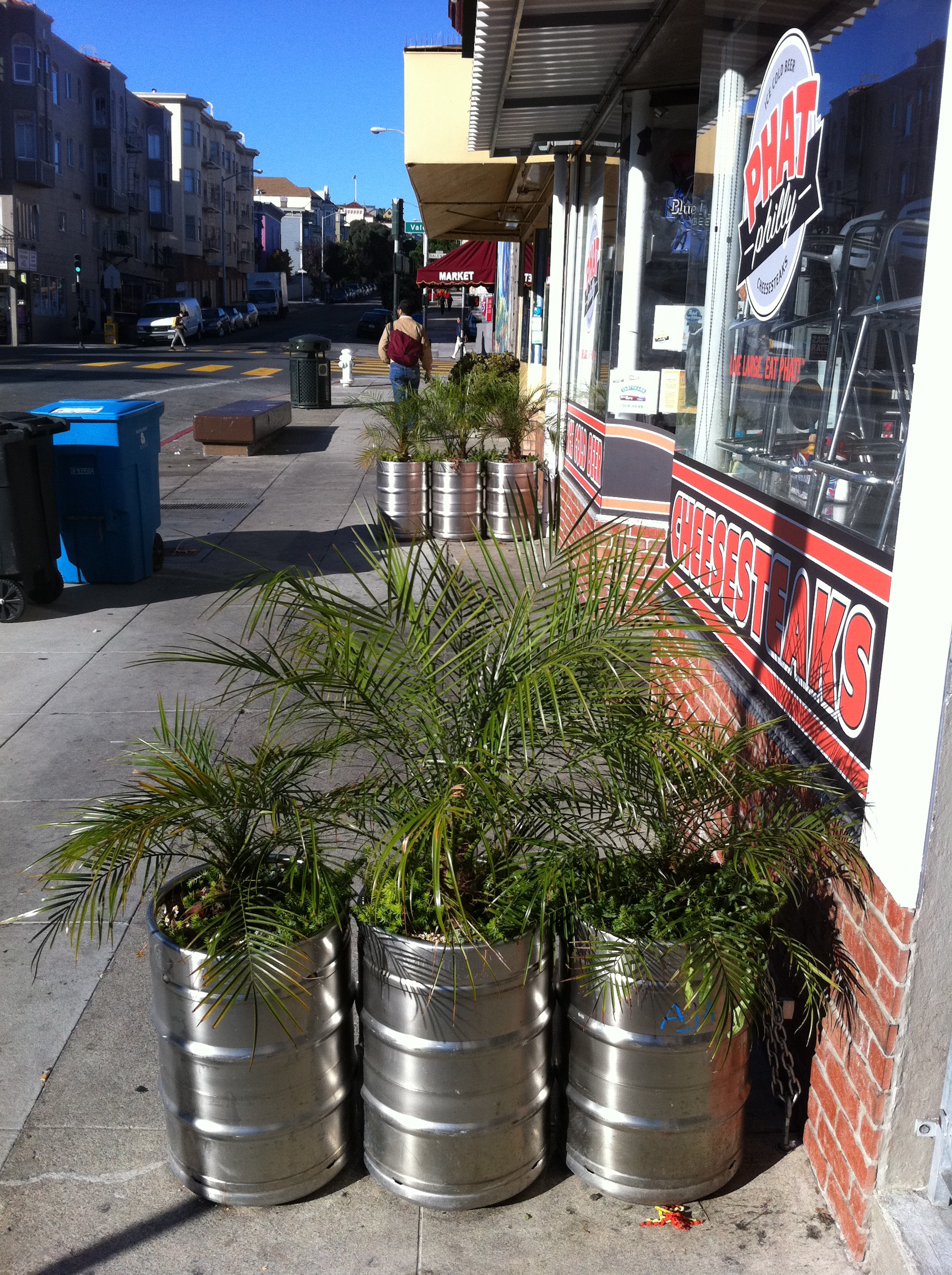
I am loving the new beer keg planters in front of Phat Philly.

There’s a garden, what a garden
Only happy faces bloom there
And there’s never any room there
For a worry or a gloom there
Googling around for something witty to end with I came across this IMDB summary for the 1946 Three Stooges movie “Beer Barrel Polecats“:
The stooges make a whole batch of homemade beer, but get tossed in jail when Curly sells some to a cop. Their minor indiscretion turns into a forty year sentence when a keg of beer Curly has hidden under his coat explodes while the boys are being photographed.
How does anyone, even Curly, fit even a small keg under a coat? A beer ball, maybe. (Hey, whatever happened to the beer ball? Those things were awesome. Can you still get them? They would be perfect for Dolores Park, no?)
Fire Truck Dance Party
“Hark, how shall we celebrate the Giants winning the World Series for the first time in 56 years, and the first time ever since they moved to SF 54 years ago?”
“Why, let us light a mattress on fire in the middle of the intersection and dance upon the firetruck that comes to put it out!”
Behold the 270 panorama of idiocy on Mission & 22nd — click here for the 10,000 pixel wide version.

Shots walking north on Mission from Cesar Chavez to 22nd, with the SFFD responding to the mattress blaze, increasingly crowded roof dance party, and the SFPD response.

Oh, Mission, I do love you, but you show some seriously poor judgement at times. Seriously, fucking with firefighters like that? What’s wrong with you? </grumpyoldmanrant>
As Brock noted, this was not a riot. (After all, a marching band did spontaneously appear after things cleared.) But we are lucky to have the most patient cops in the entire world.
More at Mission Mission, Beer & Nosh, Troy Holden, Uptown Almanac, The Tens, Holy Mountain and Telstar Logistics (including shots looking down from the Bay View / US Bank Building), and a summary by the SF Appeal — according to the SFPD, “Everyone was very happy last night, and even happy people sometimes need a police presence.”
Also, TK brings up something I have no answer to:
“Strolled down to 22nd and Mission for the Ritual Burning of the Mattresses. I was thinking, where do these mattresses come from? Is there a Mattress Guy who keeps them on hand for easy distribution any time a sports team wins a title or a white cop is acquitted of something? Where do the mattresses come from? Some people were calling it a “riot,” but Detroit is all BITCH PLEASE. YOU HAVE NO IDEA WHAT A RIOT IS.”
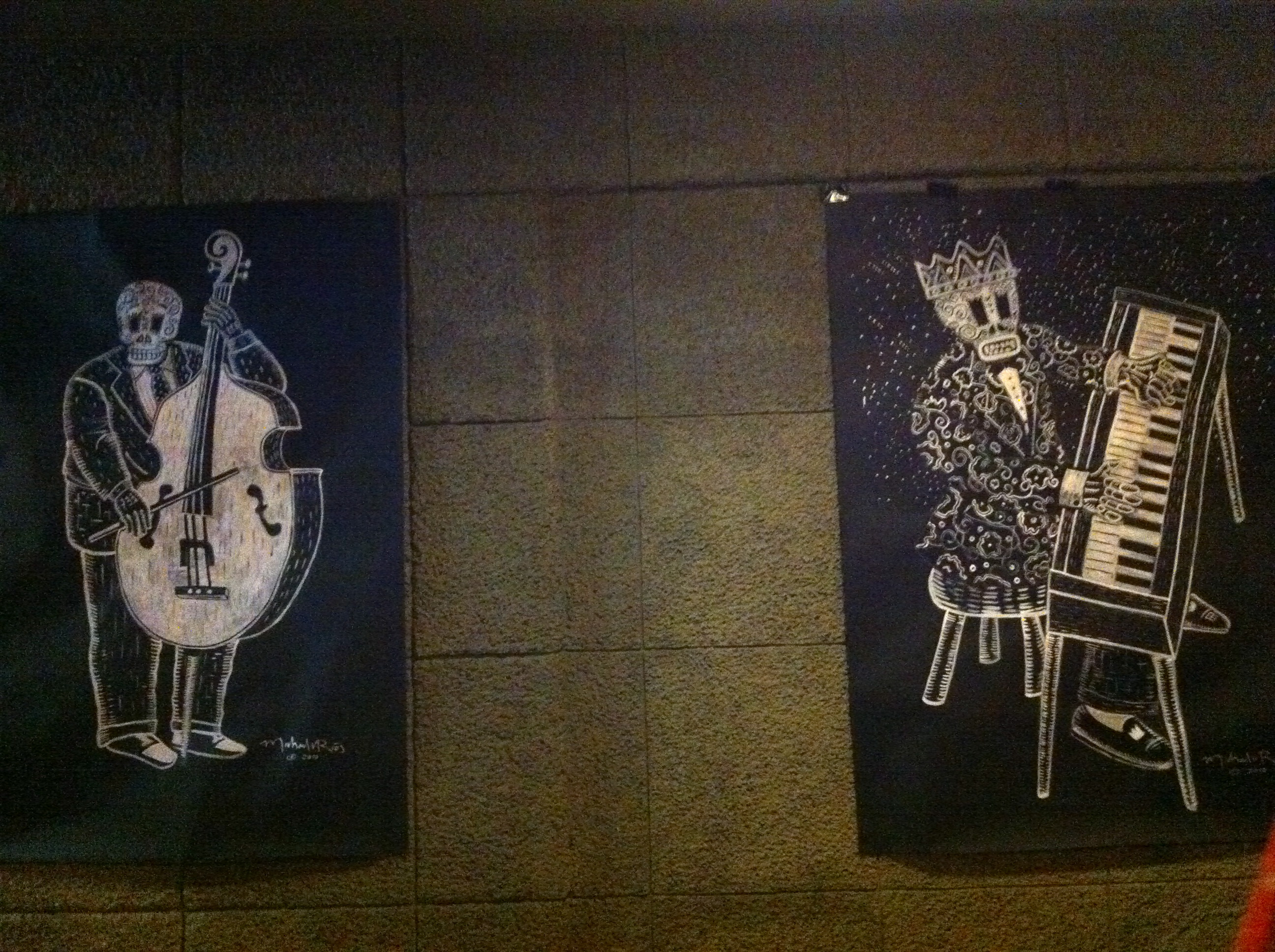
Día de las Lengua Muertas
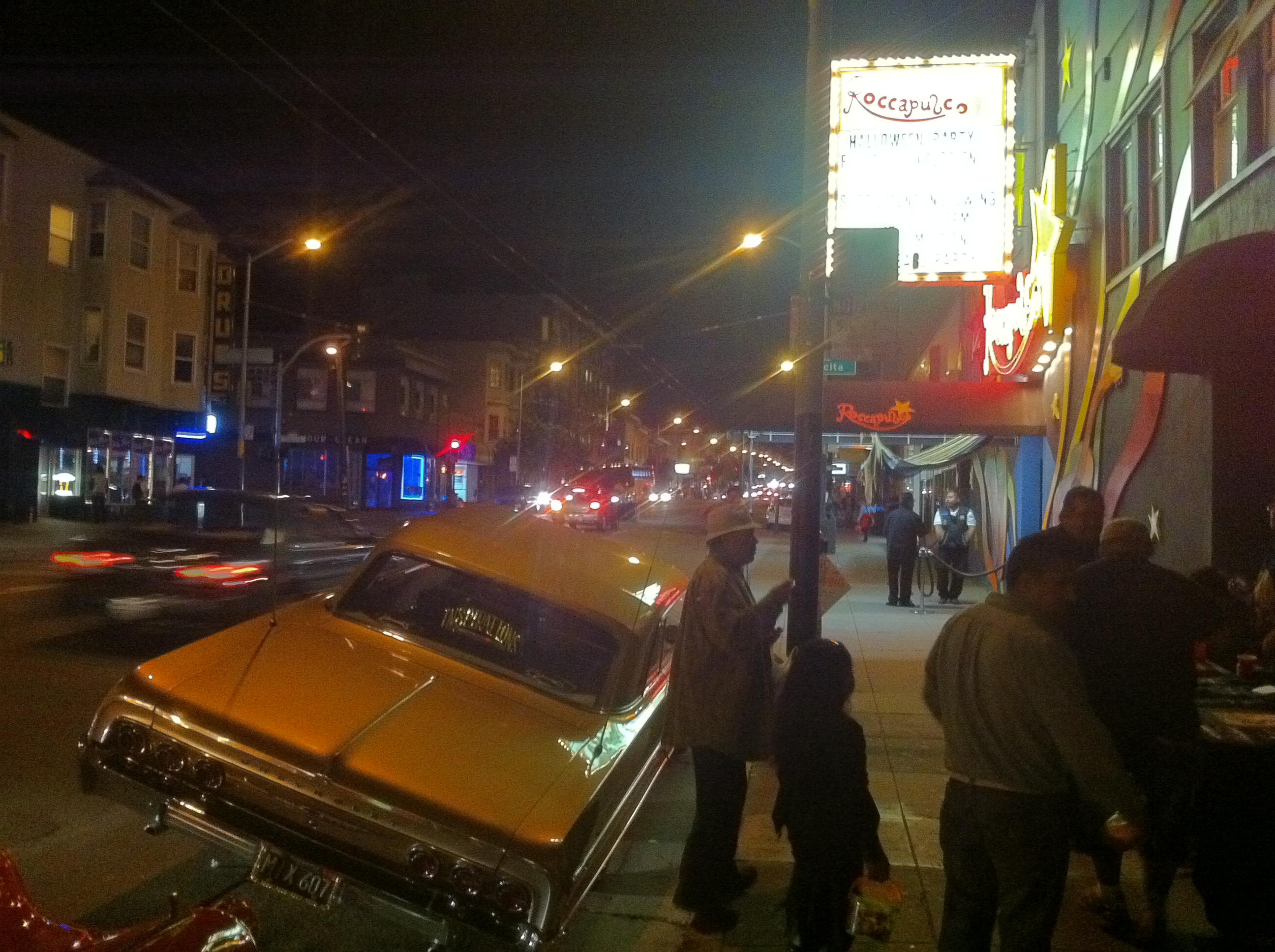
A day in the life of La Lengua:
Classic cars (technically a costume, I suppose).
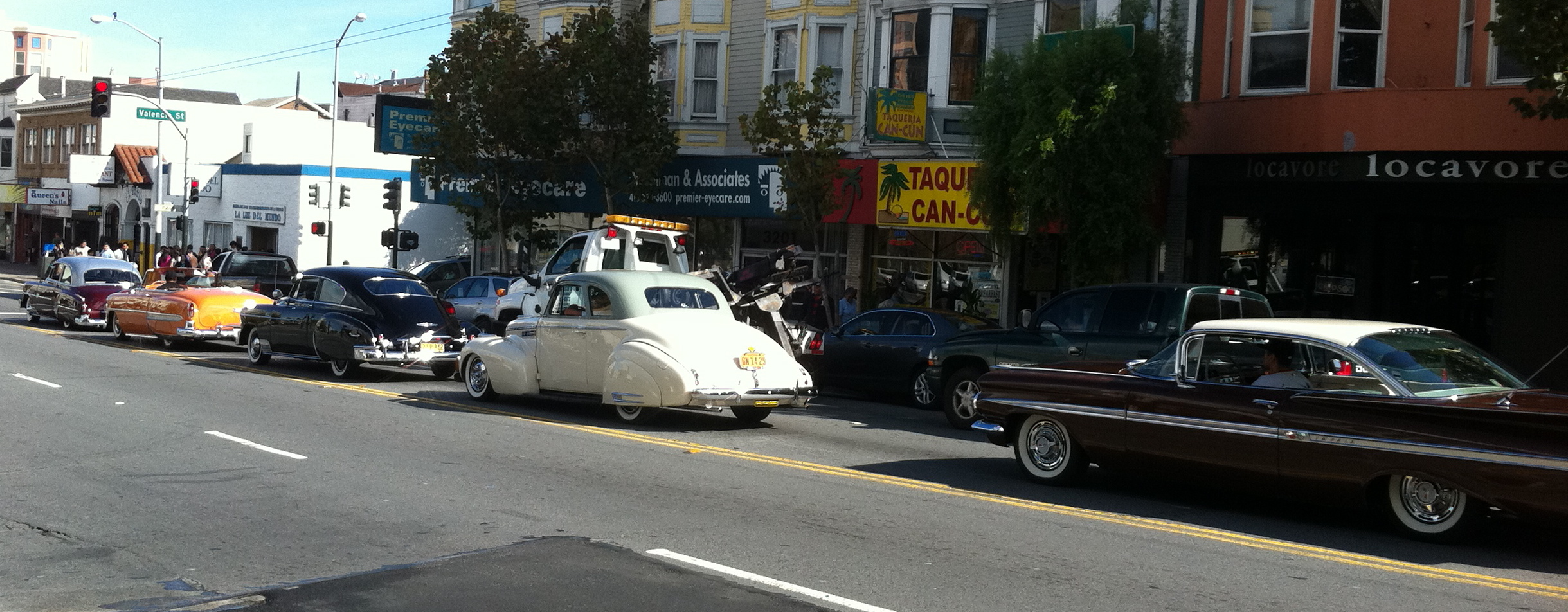

Halloween / Dia de los Muertos crossover outside Roccopulco / old Sears building.

A car on two wheels, spooooky!
This guy was particularly excited about the Giants winning game 4. For about two hours he and a friend incited about 90 decibels of honkapoolza at Valencia and Mission.
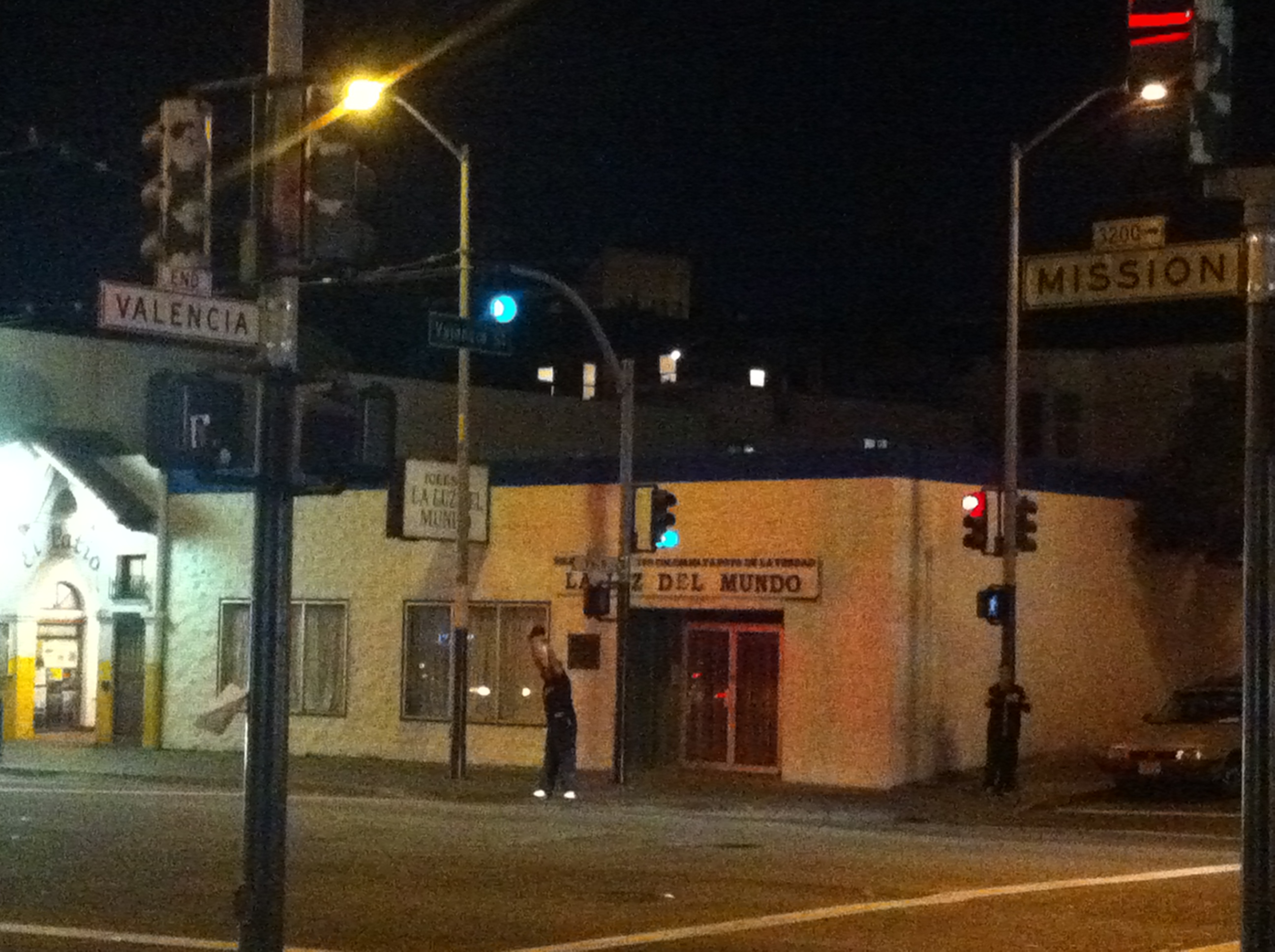
Given the premature honkulation thus far, I can only imagine how loud it will be if we win it.
360 Coverage
Nick Fisher brings us this optical puzzle, We Burn Sunlight:

OK, I give up:
- Immersive Guitar Hero?
- The inside of Coit Tower?
- A circular mosaic of Transamerica Pyramids?
- The reactor shaft of Cloud City?
- Tempest?
- My 2 year old said “Spiderweb!” Not sure if this had anything to do with certain songs we were singing earlier…
San Franthropomorphism
Looking for a Halloween costume? @Seismogenic brings us San Francisco Infrastructure Superheroes!
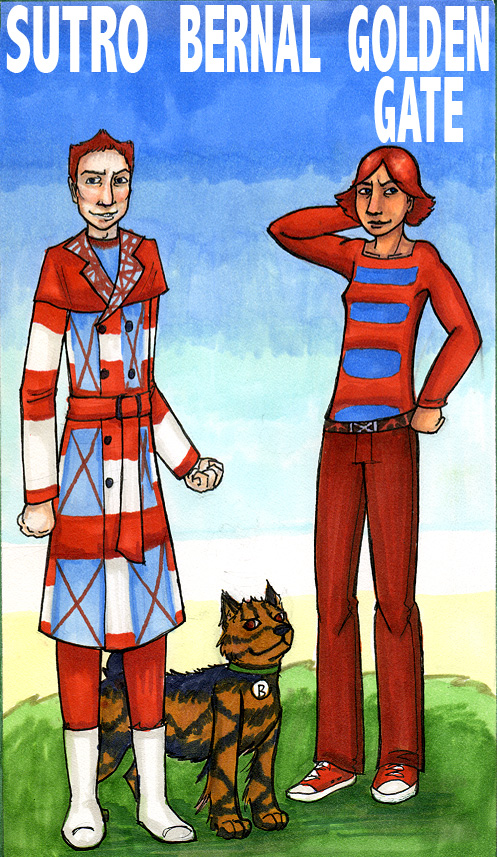
He scans the city from above, perched on his hill, ready to act. She keeps watch from sea level, welcoming to those who visit with good intentions, but prepared to stop those who intend otherwise. Together with their faithful canine sidekick, they assure the City of San Francisco that it is in good hands, should anything bad happen.
…so, uh, yeah. Couple of new characters here.
The guy on the left is Sutro Tower. It’s a television and radio tower, and is the tallest structure in San Francisco. When it’s not covered by fog, it’s visible from many parts of the City. I wanted him to look a little goofy, since it’s an odd-looking structure, but this was the first time I drew him, so his facial features could change a bit over time. He also has a bit of an origin story as a nemesis to the Golden Gate Bridge (well, according to Herb Caen), but that’s a story for another time…
The dog is meant to be the radio antenna atop Bernal Hill. There are bajillions of dogs in the Bernal Heights neighborhood, and the Hill itself is a very popular place for dog walking. It just seemed to me that the Bernal antenna had to be a dog. It was a bit tricky to get radio antenna patterns on a dog, though, especially since that antenna looks like a random jumble of parts sticking out every which way. Again, the design will surely be tweaked in future pictures.
Aaaand you already know the Golden Gate Bridge. Or, I certainly hope you do.
That is one hell of a jacket. And I am loving the canine giganticism (thanks TL!) But in all seriousness, Sutro would be a tough Halloween costume to pull off. (Scaling things up or down is tough. I was a super burrito a few years back, and to be honest I looked a lot like a giant robot / beer can.)
Anthropomorphism is all the rage on Twitter — @Fog_SF and @SFBayBridge just to name a few. Sadly, @Sutro and @SutroTower are abandoned accounts. Is there an expiration date for accounts that are clearly abandoned after a few posts?
So given this, does anyone at Pixar want to help me with my movie idea?
EXTERIOR. FOG. GOLDEN GATE BRIDGE.
Camera pans through the fog. A glimpse of the bridge. Fog closes again.
Metallic creaking sounds come from the south. Fog parts to reveal…

…Sutro Tower ripping its feet from moorings!

Sutro tri-legs it down Twin Peaks and Clarendon Heights. With increasing speed, it strides north from intersection to intersection, deftly avoiding damage through Cole Valley, Upper Haight, The Richmond, the Presidio…

to kick the shit out of whatever @hartlaubian entity is currently attacking the Golden Gate Bridge.

I am certain this movie would attract international appeal, no?
Treat Treatise
Tanforan cottages, you have met your match. Mission Loc@l reports on the discovery what is perhaps the oldest house in San Francisco at 1266 Hampshire (between 24th and 25th), dating to 1849. It has been traced to the brothers John and George Treat, whence the street name came.
“The house on Hampshire, historians said, was likely built in 1849 — the year a pair of influential pioneer brothers arrived in San Francisco — or 1850.” It was identified during the city’s South Mission Historic Resources survey.
Gregory Thomas of Mission Loc@l does a fine job referencing maps, but he makes the rookie mistake of stopping with the 1861 Langley map in the search for Treat. But going back to the 1859 US Coast Survey map, we can see the Treat compound at its original wonky angle, next to their Pioneer Race Course.

“Historians believe the house was lifted and moved about 100 feet east of its original location as streetcar lines were extended into the Mission –- reoriented to comply with a grid-style layout as the neighborhood took shape.” The concept of lifting up and moving a house simply blows my mind.
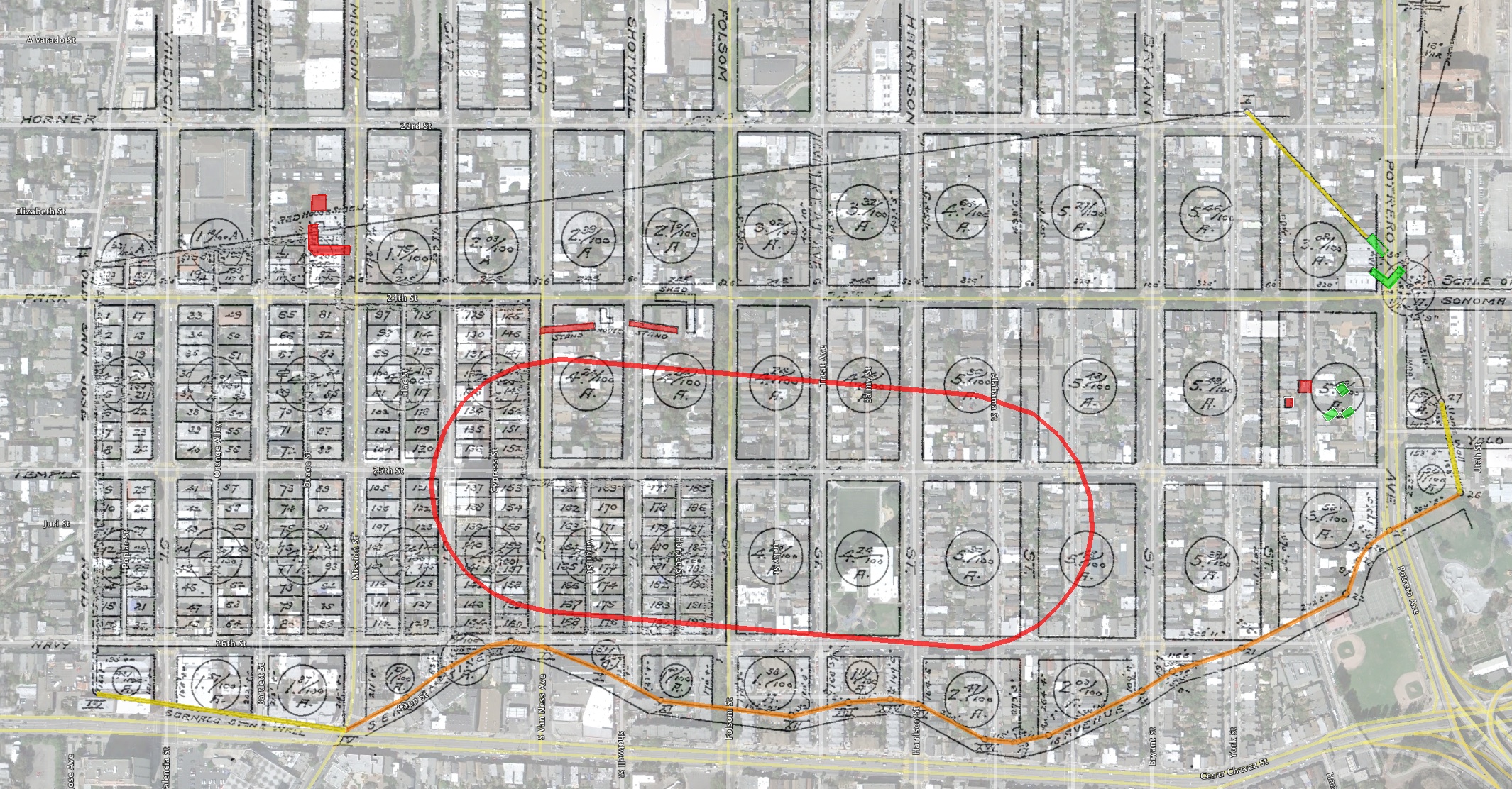
It seems like that block of three houses (marked in green) are the Treat compound. Red is the “new” position at 1266 Hampshire. The red arc is the edge of the Treat’s Pioneer race course, about 300 yards away.

(Google Earth rant — make sure you frequent save your Places. Apparently Google doesn’t believe in autosave. GE crashed and I lost about 15 hours of work on maps. Ripshit doesn’t begin to cover how I feel right now. Someone please make me an HTML5 based map/image overlay tool, OK? (Hint hint ,Stamen.))
Anyway, rant off. The San Francisco County Recorder’s office has ridiculously detailed maps of the land tracts and subdivisions through the history of the city. (Warning, not friendly to browse. A/B/1/2/3 are the oldest sets.) Here we see the 1864 submission for the “Pioneer Race Course Tract” (click to zoom):
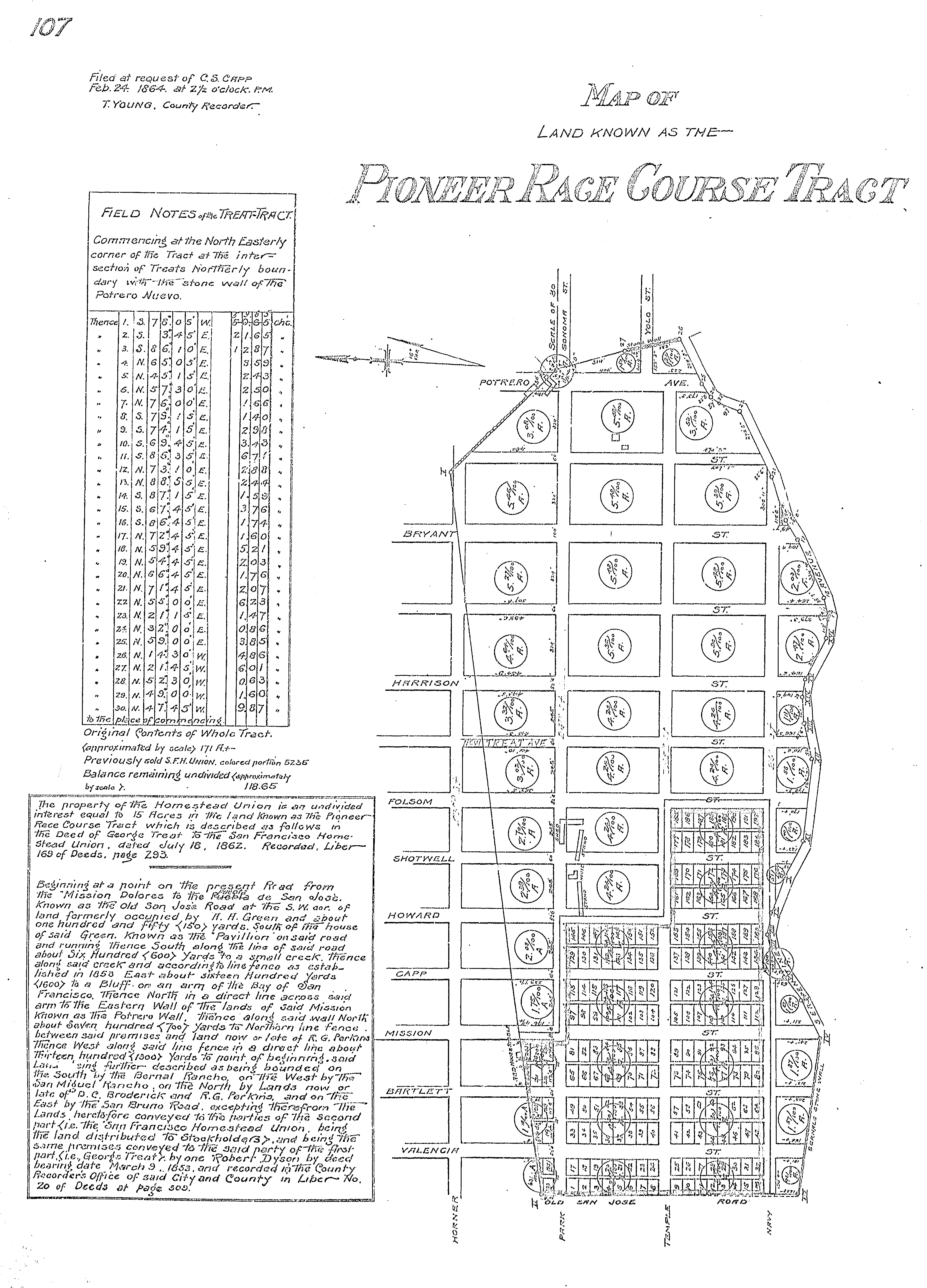
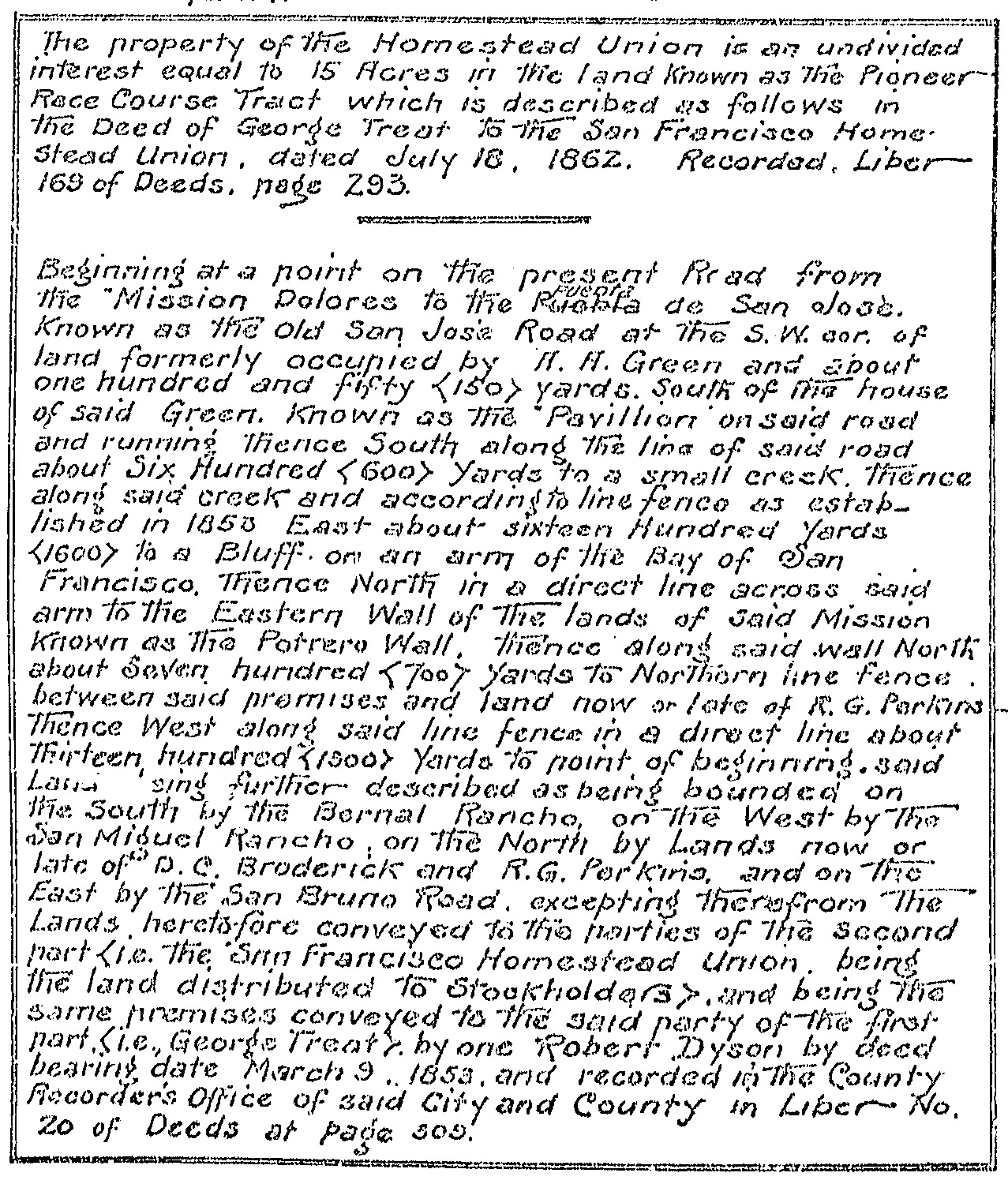
Some fascinating details in the text, describing the lands belonging to George Treat and his neighbors in the 1850s:
And of course, the requisite Google Earth transparospinoverlay (click to zoom):
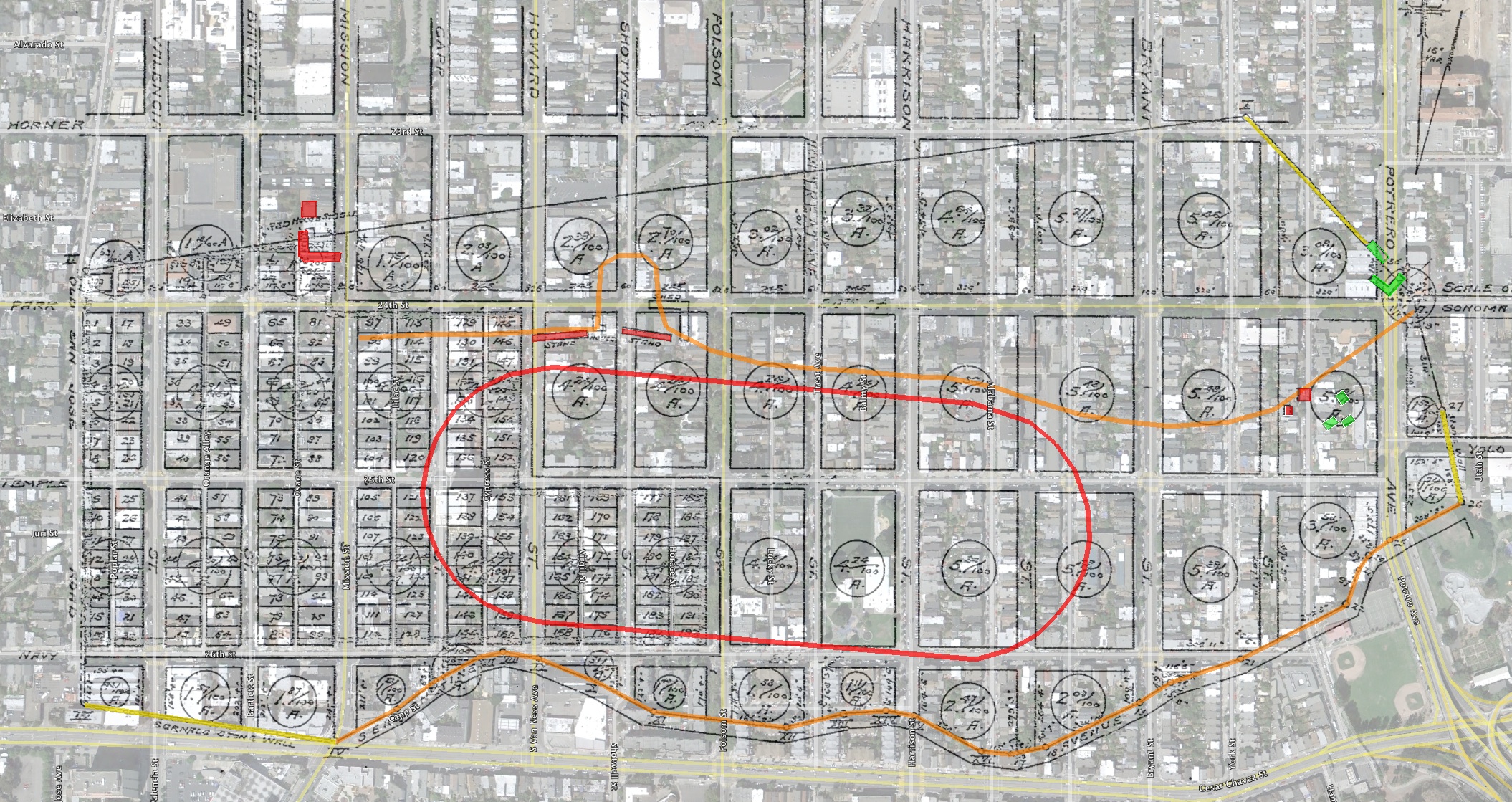
Zooming in on the Treats – the three green squares indicated in the 1859 Coast Survey map are probably their original buildings. The smaller red square is 1266 Hampshire — it looks like a second larger building also seems to have been moved once the street plan became apparent. I’m guessing they moved the houses sometime between 1857 and 1862 (when the Coast Survey Map and Pioneer Tract map were surveyed).

Other interesting details:
- the red oval is the Pioneer Race Track and the upper orange line is their path to the track — it went all the way past the grandstands (to the south of 24th, between Folsom and S Van Ness) to Mission
- the lower orange line is the boundary between the Bernal Rancho and Potrero Viejo (aka Mission Dolores)
- the yellow lines are stone walls marking the boundary to Portrero Nuevo (aka Potrero) — from the surveyor’s text, it seems that the green buildings at Potrero & 24th once belonged to “R.J. Perkins”
Looking to the west towards the road to San Jose, we see more interesting things:

- Bernal’s stone wall (more on that in another article)
- Serpentine Road, i.e. the northern border of the Bernal Racho above Precita Creek
- Capp next to the now historic Palace Steak House is one of the last remnants of Serpentine — hey, how about making that whacked corner and parking lot an history park?
- the Pioneer grandstands, theoretically pictured here:
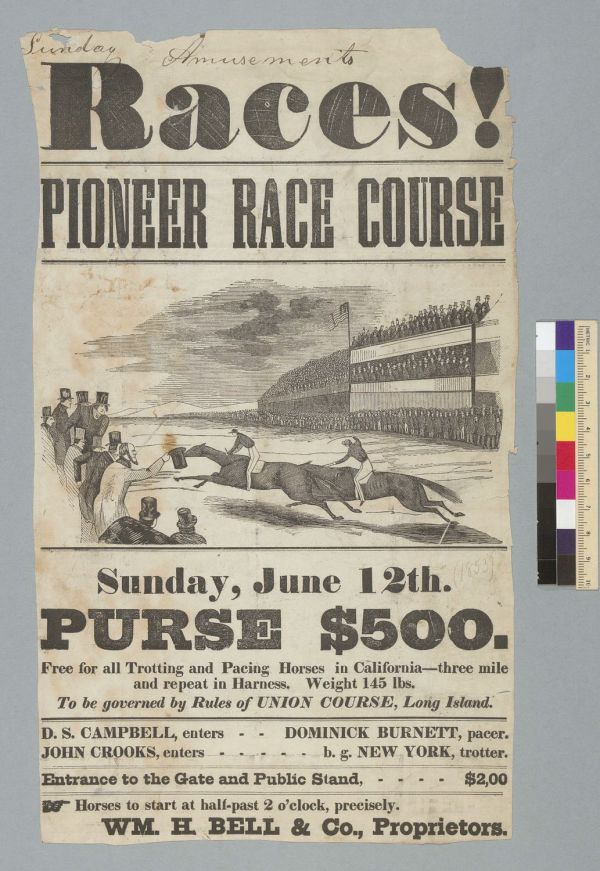
In 1924, Anita Day wrote a history of the city in the San Francisco Bulletin that I touched on this in my Mission Baseball post. The amount of detail of the Mission is stupifying — she makes mention of the Treats:

(More on the Nightingale and bars of the 1850s in another article.)
A few pages later, she interviewed the son of Will Shear, the founder of the “pear shaped” Union Race Course:

Looking at the map, you can see a place on the NW corner of 24th and Mission called the “Red House”. But then we come across this ominous reference:

This of course explains all the ghosts floating around Payless Shoe Source. ¡Fantasma de los Zapatos Baratos!
(Note I entirely avoided any Treat related Halloween puns throughout this entire article. You are welcome.)
While we’re looking into the neighborhood, anyone know the story behind the wood shingled apartments on the NE corner of S Van Ness and 26th?
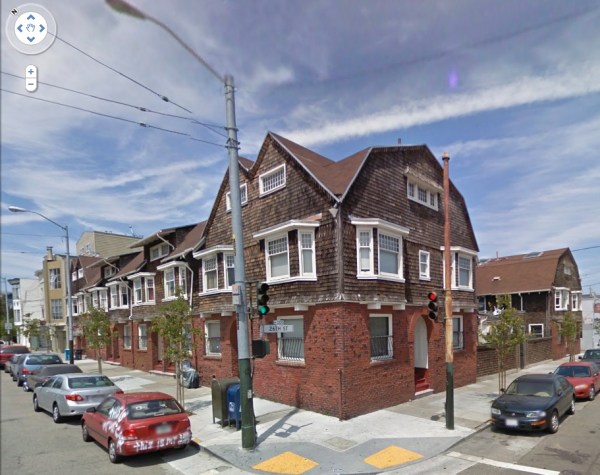
They kind of look like stables, and straddle the end of the 2nd (SE) turn of the Pioneer race course, just above Serpentine’s ghost.

First reference I see of them is the 1914 Sanborn maps.

Wondering if the architect had a sense of history.
UPDATE: Jonathan Lammers, architechælogist, lets us know in the comments that “The Arts & Crafts cottages at 26th and South Van Ness were developed by the T. B. Potter Realty Company in 1905. They are now San Francisco Landmark No. 206.”