Important Blogging Discoveries
Believe it or not, I read blogs that don’t involve Mission history, food, and maps, shocking as this may seem.
One blog I greatly enjoy reading is “40 Going On 28” by TK (a Mission man who appears to be in his late 30s but is actually 40 and complains about things). WARNING: Do not read this blog while drinking fluids, as there is a good chance you will laugh and spew a beverage over your keyboard (generally not covered by AppleCare).
While TK’s blog covers widely ranging topics, you may not realize that he is in a band and is in fact one of America’s great music researchers. Just today, during a lyrical deconstruction of Steve Miller’s Take The Money and Run, he made a significant music discovery — there is a discontinuity in Steve Miller’s story line!
We have the criminals and the crime:
They headed down to, ooh, old El Paso / That’s where they ran into a great big hassle
Billy Joe shot a man while robbing his castle / Bobbie Sue took the money and run
We have the crimefighter:
Billy Mack is a detective down in Texas / You know he knows just exactly what the facts is
He ain’t gonna let those two escape justice / He makes his livin’ off of the people’s taxes
Go Billy Mack! (Maybe he can find DB Cooper too.) But suddenly, we jump to the conclusion:
Bobbie Sue, whoa, whoa, she slipped away / Billy Joe caught up to her the very next day
They got the money, hey You know they got away / They headed down south and they’re still running today
What the hell! Clearly something happened between Bobbie Sue and Billy Mack, but what? I prompted TK on this critical gap of the criminal history of Texas, and thankfully he was able to make updiscover the missing lyrics. Read his blog to discover the details of the epic battle between Bobby Sue and Billy Mack.
Another blog I greatly enjoy reading is Mock Duck, by Dan, a Mission expat living in Prague. He’s a design guy and comes up with many wide-ranging and excellent posts on wide ranging topics from lost urban artifacts to bacon. He also has a musical bent and has written about Celine Dion (Canada’s Weapon of Mass Destruction) and more importantly multiple posts about Blues Brothers (what I consider the last, great American musical, never mind one of the best movies of all time). Here we have a Polish Blues Brothers movie poster:

It so happens that I am also a sucker for well-designed posters and am particularly fascinated by communist/socialist poster art (something Telephone and Soup were kind enough to humor). Dan has an entire post on Polish movie posters, describing how “the country emerged so devastated from WWII that it took much longer for TV and other communication technologies to make serious inroads, so the poster maintained this weirdly elevated status through the 60s, 70s and 80s.” These posters prove how constraints can inspire greatness.

However, I do require more posts about the pnuematic tube network that ran in Prague up until floods in 2002.
That is all.
T Ta Taq Taqu Taque Taquer Taqueri Taqueria
(Click to animate)
Pi In The Sky
I see the signs. The pi is near!
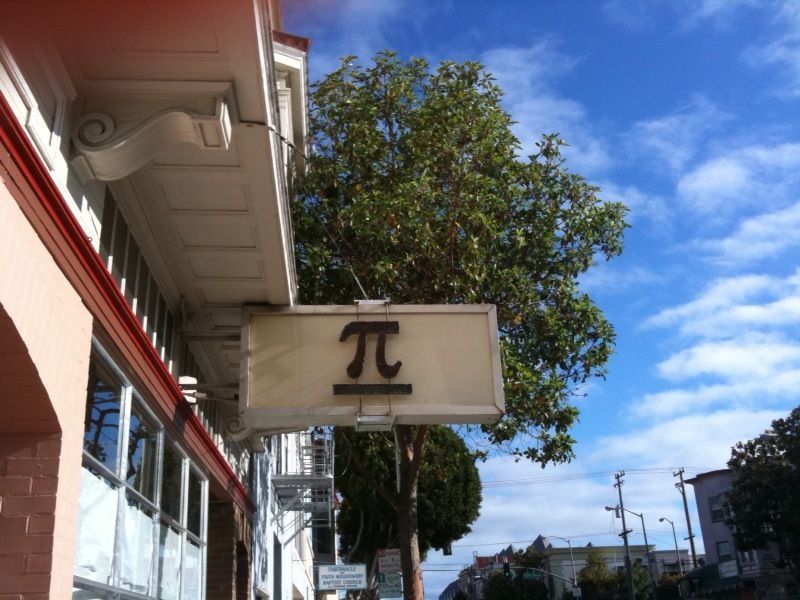
So the large pizzas at Pi Bar are supposed to be 22″ wide and have 7 slices – 22÷7, get it?? (Zagat via Grubstreet.)
But how do you cut a pie into seven slices? Very carefully, I suppose:

Or is this one of those math puzzles? “Cut into seven slices using as few cuts as possible…”
Or are they taking an asynchronous cut from Pepe’s in New Haven?
When pizza parlors started popping up all over the country, Pepe’s refused to conform to the perfect triangular slice and, to this day, slice up some pretty random freestyle shapes. Occasionally, you’ll get a triangle, but it’s definitely an accident…
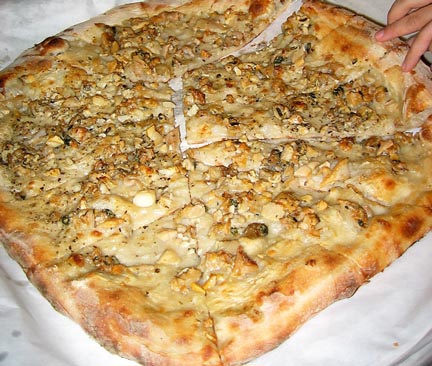
(Oh, man, clam pie. I miss clam pie in a bad way.)
Streetcar Lines, Tufte Lines
Following up on our previous 1943 red and black streetcar map — damn, this 1927 streetcar map is cool. Thanks to LibertyHiller pointing me to Octoferret’s most excellent transit scans:
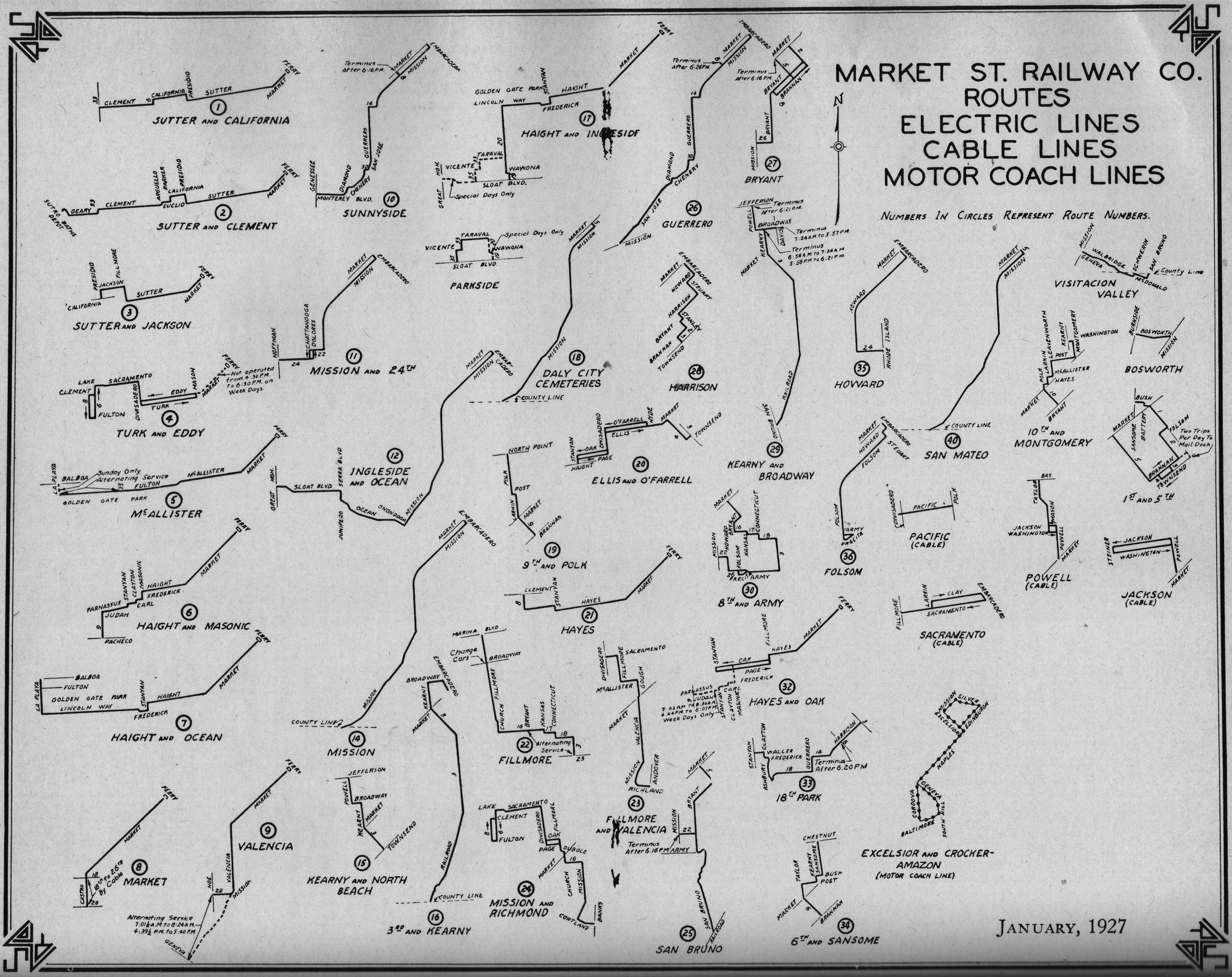
Reminds me of Zorn’s dance notations for Cachucha, via Tufte’s Invisioning Information:
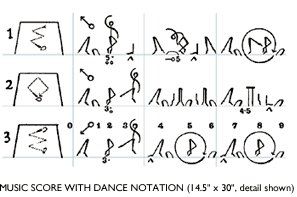
(Go buy his books and register for his SF class this December. Seriously. Now.)
Anyway, here are some of our favorite neighborhood lines. (The 23 would certainly make it easier to get to the Independent, GAMH and the Fillmore.)
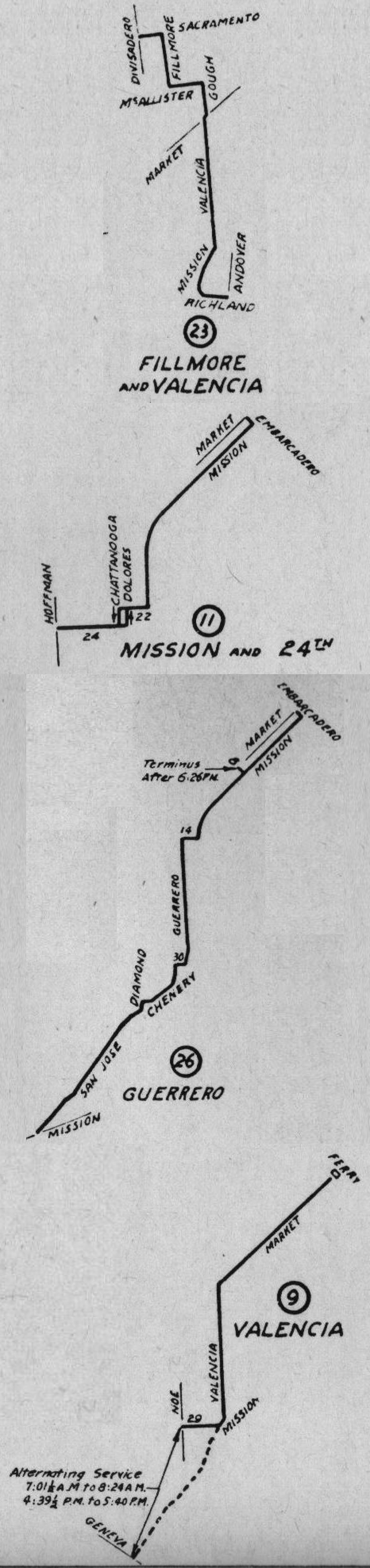
Ha, 7:01½ AM — don’t be late! (Especially if you are going bowling.)
Someone make me a 9 Valencia shirt, OK?
Streetcars on Dolores, Valencia and Guerrero
Following up on the palms on Dolores, reader LibertyHiller points us to this awesome 1943 streetcar map from CPRR.org. Click for the full version. (Nice fonts!)

Up to the early 50s, the 11 line ran down Dolores for two blocks on its way from Twin Peaks to downtown. Here we see it coming north down Dolores, about to turn east on 22nd:
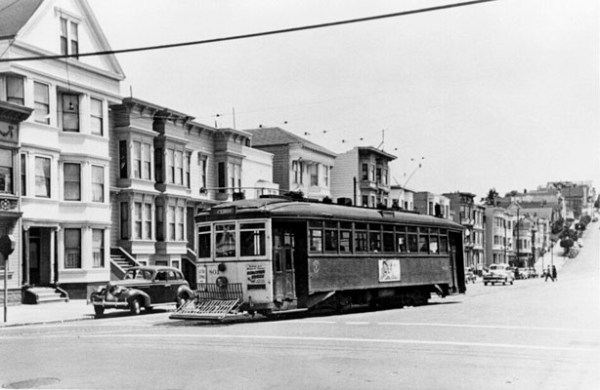
The other numbered lines should look rather familiar — the private Market St Railway Company (which ran the numbered lines) was acquired in 1944 by the city-owned Muni (which ran the lettered lines). But in the late 40s and early 50s, the city ripped out the streetcars and their rails and replaced them with futuristic buses (except for the J, K, L, M and N). The 11 line didn’t make it, and our 1958 photo shows us the newly planted palm trees in its place.
Many bus lines like the 22 and 14 follow pretty much the same routes as their streetcar predecessors. The proto-24 was a Divisidero-only line that stopped before Haight (I’m guessing they extended it through Noe once they shut down the Castro cable car line.)
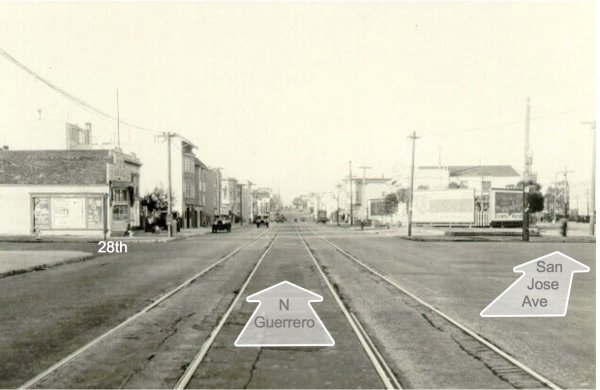
As for the other streetcar lines in the Mission, our beloved 26 ran down Guerrero instead of Valencia (until 18th where it switched over to Mission). In this 1928 photo from the SF Public Library, we see the 26 (and 10) tracks running down (a not-yet-widened) Guerrero and 28th with San Jose Ave breaking off to the right (site of the soon-to-be Pavement-to-Parks plaza).
There was a 9 line that ran down 29th to Mission and then continued on Valencia to the ferries. We’ve previously seen this 1948 shot of the 9 in front of the old Lyceum Theatre (aka Safeway).
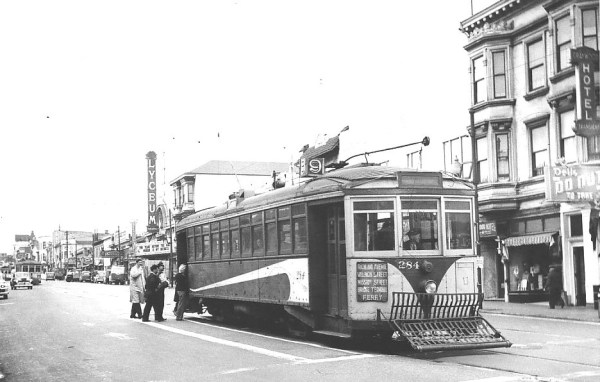
Below we have the 9 stopped on 29th, right before Mission (we are looking down 29th to the west). The 3300 Club would be the building on the left, and the Front Porch would be a few buildings down. The buildings on the right no longer exist – the 199 Tiffany building is there now, and Goood Frikin Chicken would be on the right. (Progress!!)
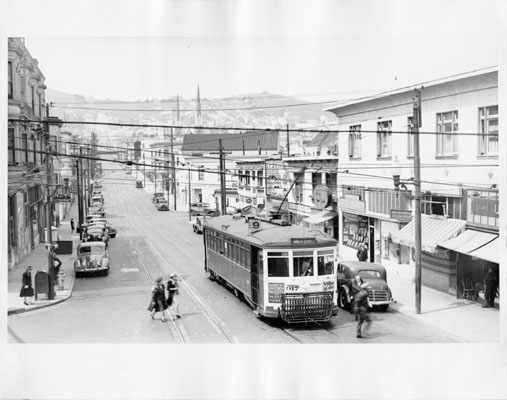
The location of the 9 line photo below is not labeled on the SFPL site, but I am fairly certain this is looking north on Valencia, right after it merges with Mission. If so, that’s Duncan and St. Luke’s on the left.
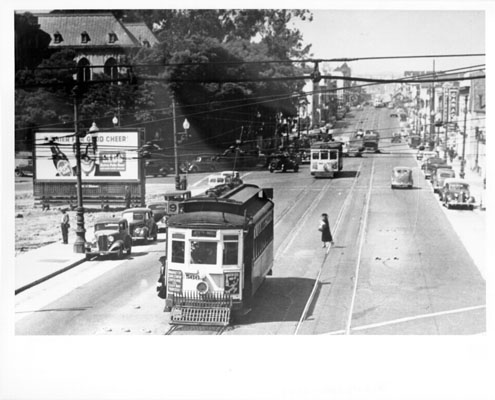
Here is the intersection of Valencia and Mission in 1945 — the shot above would be to the left. The tower on the right is the Sears building.

Lots more 9 and 36 streetcar pictures on the Bernal History Project website.
Enough for now. Believe it or not, this is all going to come back to bowling. (You think I’m kidding.)
Latino Secrets
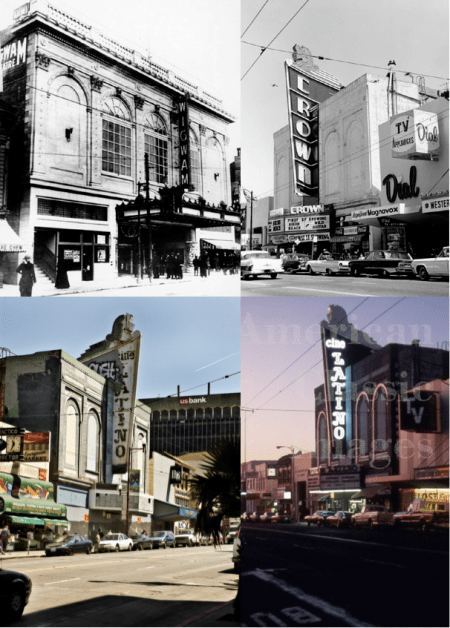
Walking by the shuttered Cine Latino after lunch, I spied a finger-sized hole in the plywood covering up the construction. I was able to press my iPhone camera lens up to said hole at various angles to take pictures of the mysterious goings-on inside, using Panolab Pro to collage them together into this semi-respectable view. Click to zoom.

What’s going on here, owners? I certainly like the high ceilings. What’s next for the Cine Latino / Crown / Rialto / Wigwam?
Know Your Trees
So it is turning into Tree Week here. Following up on comments on pictures of palm trees in Dolores Park, I came across Michael Sullivan’s book The Trees of San Francisco.
It has some stark descriptions of a treeless San Francisco:
– Shortly after arriving in San Francisco in 1776, the Spanish described the area as “the very worst place [for settlement] in California . . . since the peninsula afforded neither timber, wood nor water, nothing but sand, brambles and raging winds.”
– Before the gold rush, “much of San Francisco was largely treeless, its grassy hills interrupted by only a few live oaks and California buckeyes huddled in wind sheltered valleys.”
– when Nikita Khrushchev visited San Francisco in 1959, he reportedly commented on the city’s beauty but noted the remarkable lack of trees.
Things got better — trees were planted as the city grew, but this 1887 photo looking at the Presidio towards the Golden Gate shows how stark the landscape was. The eucalyptus, pines and cypress planted in 1882 are what you see today. (Historical images from SFPubLib and Calisphere.)

(Hover/click on any of these images to get to the original source.)
And here we have miniature palm trees in Dolores Park from 1909. This was first picture of palms in the park I can find — they didn’t seem to be there pre-earthquake).
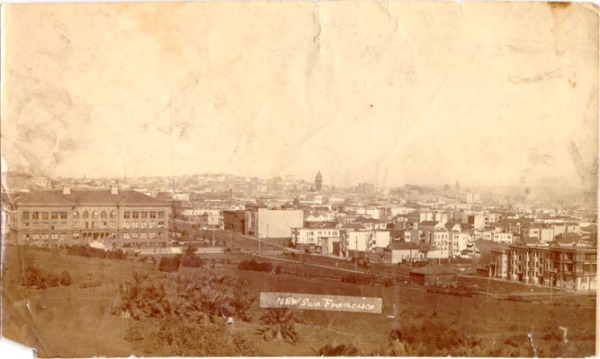
This picture is undated, but I’m guessing the early 1920s given the buildings size of the trees on Dolores St. (I don’t think those palms grow very fast.)
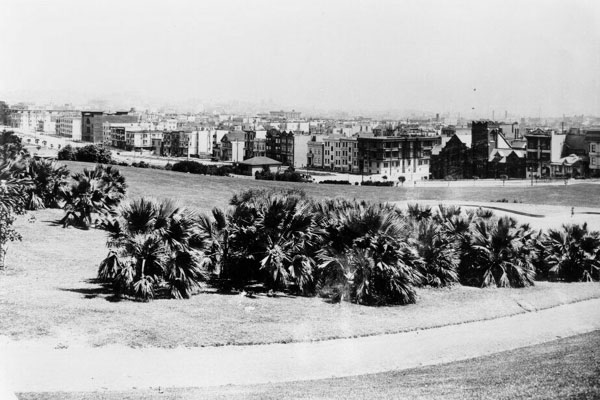
Here we have kids on the swings in 1929.
![1929 Jan 28 Babies getting the air in Mission Park on Dolores Street] [graphic]. AAA-6820](https://burritojustice.com/wp-content/uploads/2009/07/1929-jan-28-babies-getting-the-air-in-mission-park-on-dolores-street-graphic-aaa-6820.jpg?w=600 "1929 Jan 28 Babies getting the air in Mission Park on Dolores Street] [graphic]. AAA-6820")
(These kids would now be in their 80s.)
Swings and trees, 1935:

1964:
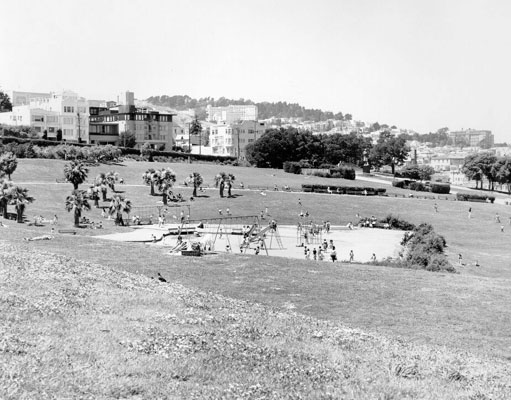
Slowest. Trees. Ever.
Dolores St seems to have gotten its boulevard palms in stages, starting in the 1920s.
1934: short palms at Dolores and 22nd (big gap to the south):

No palms looking south on Dolores from 23rd, 1923 (though there are some on the top of the hill):
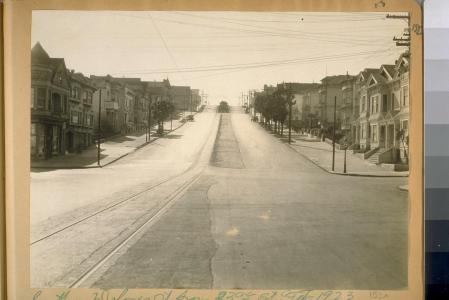
Opposite direction, 1958 (looking north from 24th street):

The book has a list of the 20 most popular trees planted by Friends of The Urban Forest since they started in 1981 following budget cuts that effectively killed the city’s tree planting program. (They plant about 1000 a year, 43,000 since 2004. Go donate.)
Reading through this list I only recognized a few of the names, but when I started looking them up they all looked familiar. I share my newfound pattern matching with you, internet. Most pictures from FUF’s flicker feed, latin names point to Wikipedia.
1. purple Leaf Plum (Prunus cerasifera) – Cultivation

2. Japanese flowering cherry (Prunus serrulata) – Japan

3. New Zealand Christmas tree (Metrosideros excelsus) – New Zealand
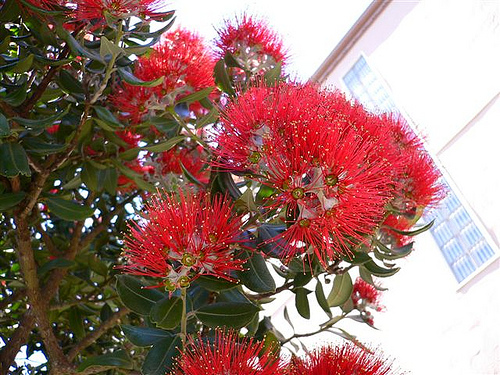
4. small-leaf tristania (Tristaniopsis laurina) – Australia

5. strawberry tree (Arbutus unedo) – Europe
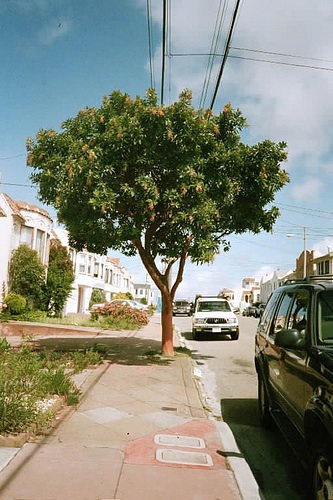
6. Brisbane box (Lophostemon confertus) – Australia
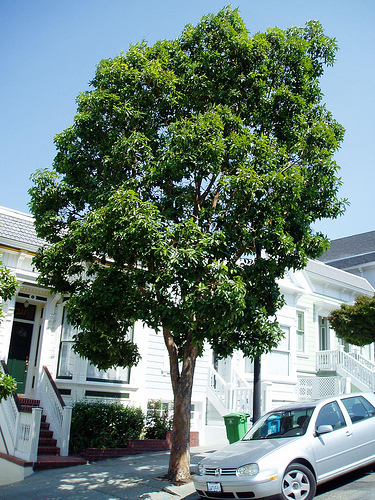
7. Victoria box (Pittosporum undulatum) – Australia
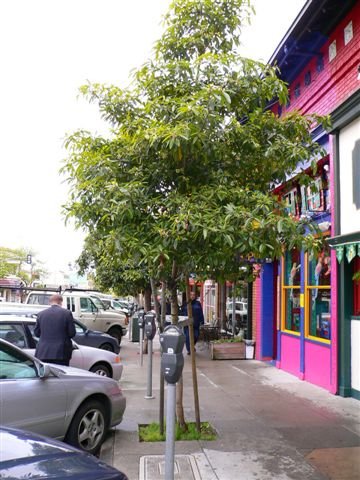
8. mayten (Maytenus boaria) – Chile and Argentina
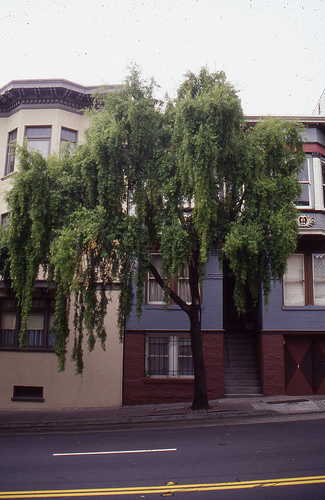
9. southern magnolia (Magnolia grandiflora) – United States

10. ficus (Ficus microcarpa) – Asia
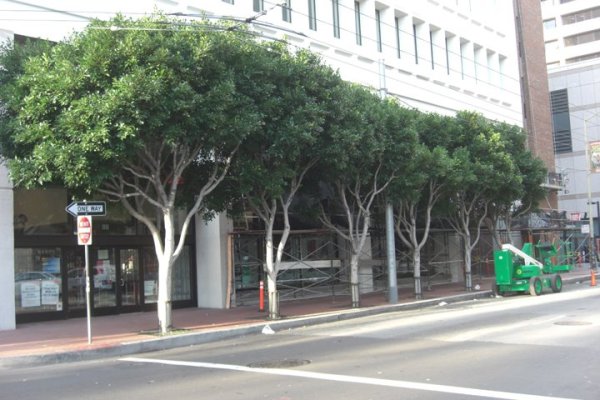
(Don’t think they are planted any more — they buckle sidewalks, and a freak freeze in 1990-1991 killed many off, according to TTOSF. A bunch on Potrero? The above is Spear.)
11. Bailey’s acacia (Acacia baileyana) – Australia

12. bronze loquat (Eriobotrya baileyana) – Asia
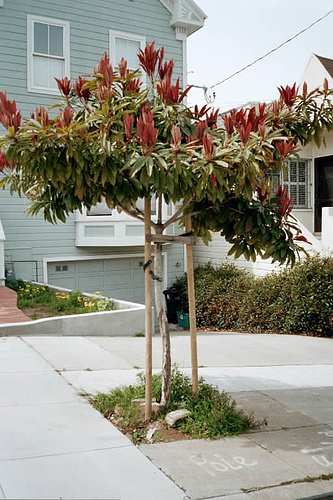
13. Indian hawthorn (Rhaphiolepsis ‘Majestic Beauty’) – Asia

14. hopseed (Dodonea viscosa) – Australia, others
_in_Hyderabad,_AP_W_IMG_9821.jpg "Dodonaea_viscosa_(Hopbush)_in_Hyderabad,_AP_W_IMG_9821")
15. cajeput tree (Melaleuca quinquenervia) – Australia.

(Now I’m no botanist, but cajeput is coming up as Melaleuca linariifolia, which is described as “spongerubbery” while quinquenervia is a) hard to type, b) invasive in Florida per this exciting report, and c) often described at a Paper Bark Tea Tree, so don’t get your trees in a knot.)
16. callery pera (Pyrus calleryana) – Asia

17. ginko (Ginko biloba) – Asia
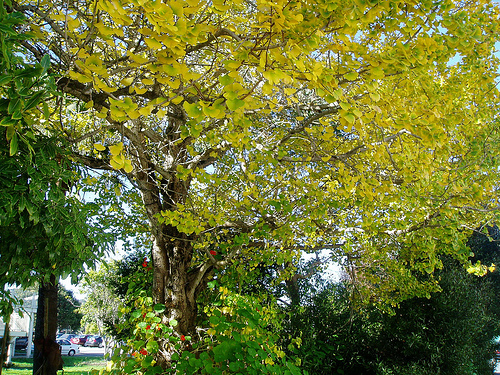
18. olive (Olea europaea) – Mediterranean

(There are olive trees more than 2000 years old in Portugal and Crete!)
19. glossy privet (Ligustrum lucidum) – Asia

20. evergreen pear (Pyrus kawakamii) – Taiwan

Moving from new trees to old trees, many in the city are getting landmark status. Some palms on Dolores are protected, as is the huge Moreton Bay fig in front of St. Luke’s on Valencia (which unfortunately lost a branch last month.) These and other important trees are listed on the Landmark Trees page.
Our Valencia Street moreton bay fig in all its glory:

Anyone know how old it is?
Chicharrones Cheeseburger = Particularly AWESOME
Thursday Ferry Building Farmers Market well worth attending. The dog was good, but the 4505 cheeseburger was epic.

And my first Gobba Gobba Hey! Mmmmm.
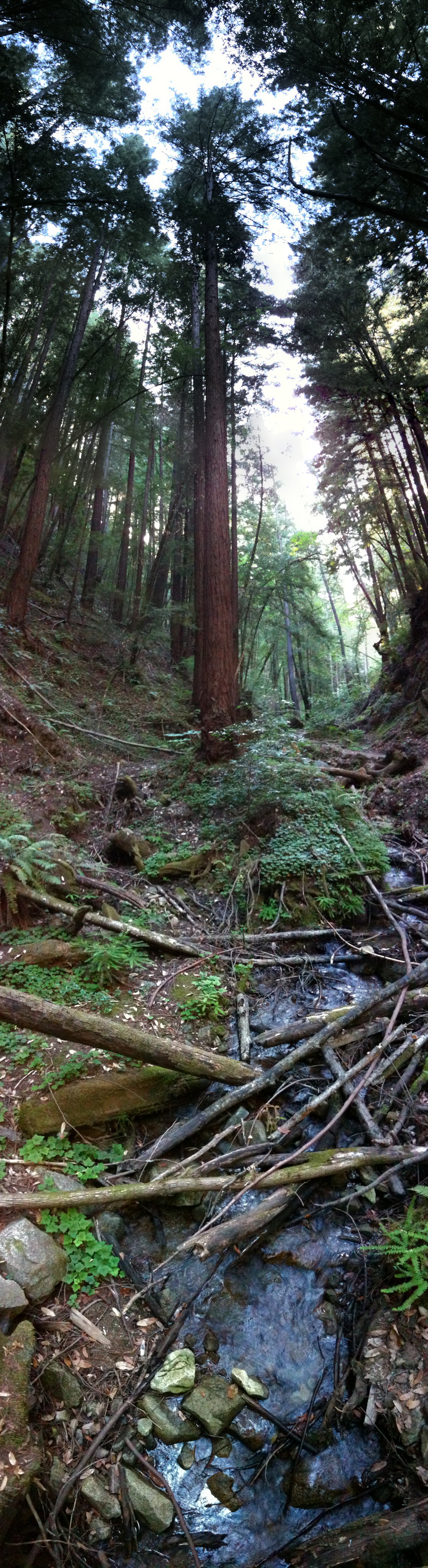
Tall Tree, Short Creek
I thought I would surprise you all by including a non-fog related picture – Henry Cowell State Park near Santa Cruz.
Pyroclastic Fog
It seems to be Fog Week here in the San Francisco blogosphere. Plug1 took this fantastic shot from a plane this weekend of our vapor-ladened friend attacking the bridge:

My meager efforts are limited to ground based fogtography. 280 North, just before 380, taken from my cleverly designed iPhone windshield mount — click the images below for melodramatic cross-faded quicktimes:


When it’s piled up and roiling like that, I can’t help but feel like I’m driving towards Mt. St. Helens.